Good evening friends and neighbors,
We are almost certainly in the final week of the legislative session, and I wanted to send the first of several updates this week on some of the larger bills still moving through the State House.
This update focuses primarily on education finance and governance proposals, including H.955 and the annual yield bill, H.949, both of which continue to evolve quickly as negotiations continue between the House and Senate.
I also included an update on changes being proposed to Vermont’s cannabis laws, as well as an update on H.686, a bill I introduced this year focused on transparency in paid lobbying advertisements. H.686, along with H.727, the large energy load and data center bill I introduced this year, have each passed the House and Senate and both been sent to the Governor for his consideration.
Many of these bills remain active negotiations, and additional changes are still possible before final votes are taken. I will continue providing updates as we move through the final days of the session.
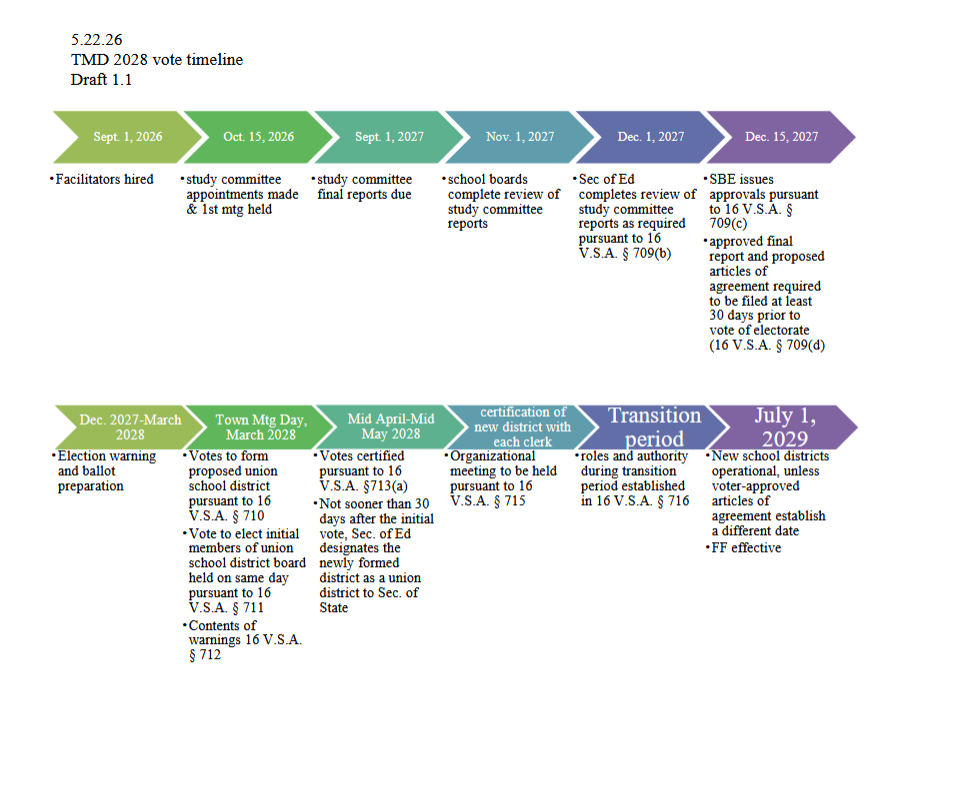
The Senate has proposed significant changes to H.955 that move more aggressively toward regional district mergers. The proposal changes “study committees” into “merger committees,” accelerates timelines, requires districts to participate in the process, and places greater emphasis on regional middle and high schools and universal access to career technical education. The current proposed timelines are posted above. The current fiscal note can be found here. The image above is of the current timeline for bringing potential mergers to town votes.
Under the current Senate proposal, merger committees would begin meeting in fall 2026. Final recommendations would be due by September 2027, followed by State Board review later that year. Votes on proposed mergers would then occur on Town Meeting Day 2028.
One of the questions many communities are asking is what happens if a town votes no.
Under the Senate proposal, the answer depends on how the merger plan is written. If a town is identified as “necessary” to forming the proposed new district, a no vote could stop that merger from moving forward. If a town is identified as “advisable,” the proposal may still be able to move ahead without that town, depending on the final articles of agreement and State Board approval.
A no vote would not necessarily end the conversation. The proposal could potentially be revised, or a district that does not merge by July 1, 2028 could later seek legislative approval to join a neighboring unified union school district. That later step would require action by the General Assembly.
At the same time, the Senate proposal is clearly designed around encouraging larger regional systems. The proposal also includes a moratorium through fiscal year 2035 on towns petitioning to withdraw from or dissolve a union school district. That language was not included in the House-passed version.
I understand why this is creating concern in communities like Jamaica, where residents have struggled to meet the current legal thresholds required to leave a union district.
When I met with both Jamaica residents and River Valley representatives this session, I encouraged everyone to participate in the committee process in good faith. These larger regional conversations are difficult, but they may also help create better long-term solutions for students and communities.
I also suggested communities consider nonbinding advisory questions on the November ballot heading into next session so voters can more directly express their priorities before additional legislative decisions are made.
It is also important to note that this remains very fluid. The House has requested a conference committee and named Rep. Conlon, Rep. Kornheiser, and Rep. Quimby as conferees. The Senate has appointed Senators Bongartz, Hardy, and Mattos as conferees.
As a reminder, I will be holding an online meeting on Saturday, May 30 at 9:00 a.m. to discuss the latest proposed language and current timelines.Zoom link.
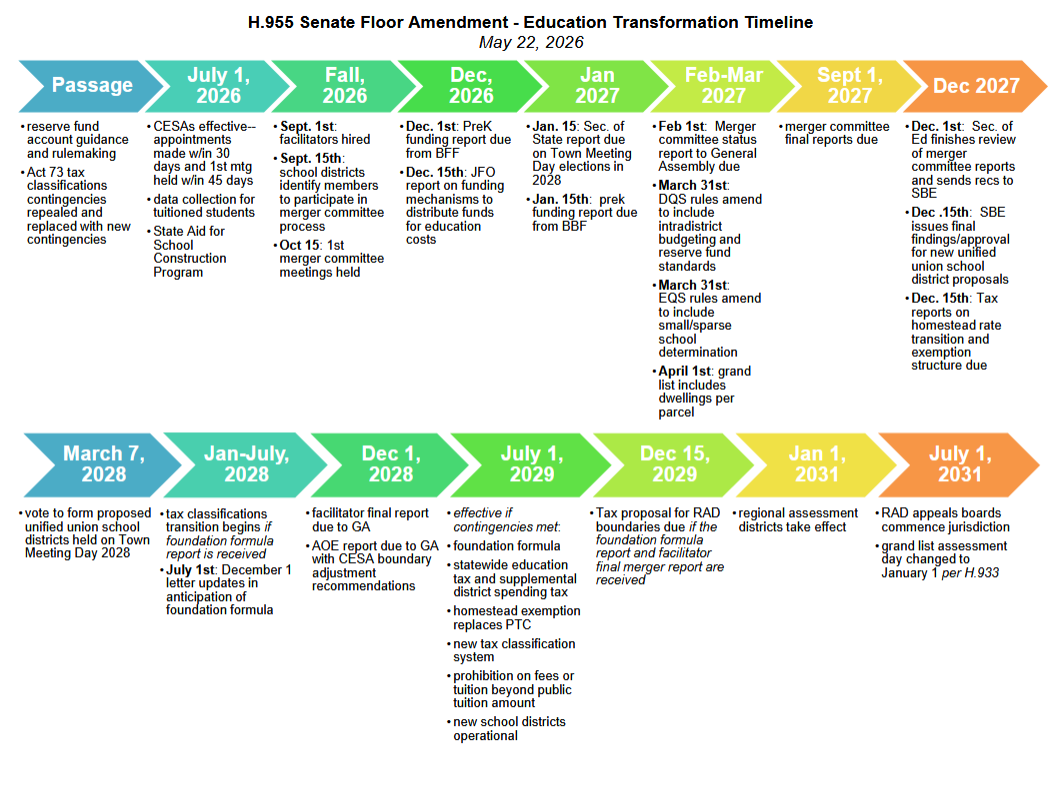
H.949, the annual yield bill, remains in conference committee.
The bill sets the statewide education property tax yields and nonhomestead tax rate for fiscal year 2027 and makes several additional education finance changes.
Under the current Senate proposal, the Joint Fiscal Office estimates the bill would result in an average statewide education property tax increase of approximately 3.8%.
The Senate proposal also lowers the excess spending threshold from 118% to 112% beginning in fiscal year 2028 while expanding exemptions for voter-approved school construction bond payments. The fiscal note estimates that if the proposal had been in effect this year, roughly $21 million in school spending would have exceeded the excess spending threshold compared to approximately $4.7 million under current law.
The proposal also temporarily expands the Vermont renter credit for claim year 2027 by increasing both the maximum credit amount and the percentage of fair market rent used in the calculation.
Additional sections address special education census grant inflation adjustments, a repayment issue related to Barre’s TIF district, and technical education finance corrections. Current fiscal note
The current conference committee members are:
- Rep. Emilie Kornheiser
- Rep. Charles Kimbell
- Rep. Martha Feltus
- Sen. Ann Cummings
- Sen. Thomas Chittenden
- Sen. Scott Beck
H.686 Update: Transparency in Paid Lobbying Advertisements
I introduced H.686 this year because Vermont has a loophole in our lobbying disclosure laws that allows national advocacy organizations to spend heavily on political advertising outside the legislative session without the same transparency requirements that apply during the session.
Groups like fossil fuel funded Americans For Prosperity can – and have – run expensive advertising campaigns intended to shape public opinion about legislators, candidates, and political issues while avoiding the disclosure rules Vermonters reasonably expect. That is especially concerning in election years.
This bill does not limit speech, advocacy, or political organizing. It simply says that if organizations are spending significant money trying to influence Vermonters through paid lobbying advertisements, the public should be able to see who is paying for those campaigns.
The House passed H.686 earlier this year with language that broadened the definition of lobbying advertisements to include not only traditional media like television, radio, newspapers, and websites, but also mass-distributed communications such as robocalls, mass mailings, and paid online messaging.
When the bill reached the Senate Government Operations Committee, senators made several changes. Most significantly, the Senate added a new reporting requirement for lobbying advertising campaigns costing $1,000 or more. Under the Senate version, organizations would have to disclose:
- who paid for the advertisement,
- how much was spent,
- who received the payment,
- what issue or bill was being discussed, and
- whether the advertisement supported or opposed the issue or person featured.
The Senate also narrowed the House definition of “advertisement.” The House language more clearly covered things like mass texting campaigns and other broadly distributed communications. The Senate version returned to a more traditional advertising definition focused mainly on television, radio, newspapers, and websites.
I continue to believe Vermonters deserve greater transparency around who is funding political influence campaigns in our state. Whether people agree or disagree with the messages being promoted, voters should be able to evaluate that advocacy with full information about who is paying for it.
H.686 now moves to the Governor.
Changes to Cannibus
The House has proposed a number of changes to S.278, the cannabis bill currently moving through the Legislature.
Some of the most visible changes would:
- increase the legal possession limit for adults from one ounce to two ounces;
- increase the transaction limit for retail sales from one ounce to two ounces;
- increase the THC limit in a single package of edible cannabis products from 100 mg to 200 mg; and
- reduce licensing fees for many outdoor cannabis cultivators.
The bill would also create a temporary pilot program allowing permitted cannabis events where adults 21 and older could legally consume cannabis products on site, subject to approval by municipalities, security requirements, and Cannabis Control Board oversight.
The House proposal also makes several structural changes to Vermont’s cannabis system, including repealing the “integrated license” structure that currently allows medical dispensaries to operate across multiple parts of the cannabis market under one license.
Another significant section would allow the Governor to enter into future interstate cannabis agreements with other states if federal law or federal enforcement policy changes enough to allow legal interstate cannabis commerce.
The proposal also includes new protections for renters by prohibiting lease provisions that completely ban possession of cannabis inside a rental unit, though landlords could still prohibit smoking or inhaled cannabis use inside buildings.
The current fiscal note also highlights several financial impacts. The event permit pilot program is expected to generate a maximum of about $5,000 annually for two years, split between host municipalities and the Cannabis Regulation Fund. The proposal to reduce outdoor cultivator licensing fees would lower Cannabis Regulation Fund revenue by roughly $105,000 annually unless the Legislature transfers or appropriates replacement funding. The fiscal note also notes that changes related to cannabis business deductions and property tax credit calculations could have a small impact on Education Fund revenues over time. Current fiscal note
As with many end-of-session bills, this remains an active negotiation and additional changes are still possible before possible final passage and before the bill can be sent to the governor for consideration.
If you need help with state services, please reach out. I do not have staff and I work year-round, so if you do not hear back in a day or two, please follow up or send a text. If you find my work useful and are able to support it, you can do that here.
Thank you for staying engaged and staying in touch!
Rep. Laura Sibilia
Windham-2 District (Dover, Jamaica, Somerset, Stratton, Wardsboro)
Email: lsibilia@leg.state.vt.us
Phone: (802) 384-0233
Sibilia Announces Campaign for Reelection to Represent Windham-2
Discover more from Vermont State Representative Laura Sibilia
Subscribe to get the latest posts sent to your email.
 Vermont State Representative Laura Sibilia