
Good evening friends and neighbors,
In this newsletter, I will provide an overview of where things stand on the budget and education, what was ultimately passed.
I also want to make it easier for residents to connect with me directly on these issues. Beginning this summer, I plan to expand my regular office hours throughout the district. In addition to my monthly office hours in Dover (1st Saturday of the month at 11 am at the Dover Free Library Tomorrow!) and Wardsboro (3rd Thursday of the month at 6 PM at the Wardsboro Library), I am working to establish a regular location in Jamaica for evening meetings on the 2nd Wednesday of the month and hope to begin those meetings in July.
Given the importance of the education discussions ahead, I also intend to attend as many public meetings of the River Valleys Unified School District Board and the West River Education District as possible. River Valleys typically meets on the first and third Mondays of each month at 6, and WRED generally meets on the second Monday of each month at 7. While legislative duties, work, and family obligations will occasionally create conflicts, I hope these meetings, together with expanded office hours, will provide additional opportunities to hear directly from constituents as our communities navigate significant changes in education policy.
As always, thank you to everyone who has reached out, attended meetings, and shared your perspectives throughout the session and these important discussions.
Budget
The Legislature approved H.951, the state’s annual budget bill. The final budget appropriates approximately $9.38 billion across all funds, an increase of about 2.1 percent over the current fiscal year. General Fund appropriations total approximately $2.57 billion, a 2.9 percent increase over FY2026.
The final budget includes funding for state government operations, public safety, education, health care, housing, transportation, economic development, and environmental programs for the coming fiscal year. It also fully funds required reserves and pension obligations.
The budget includes a one-time transfer of approximately $100.9 million to the Education Fund to help reduce education property tax increases as part of this year’s education finance package.
The budget also includes funding for housing and homelessness programs, health care and human services, education initiatives, flood recovery and resilience efforts, economic development programs, and a variety of workforce and community support programs throughout the state.
As with most budgets, H.951 reflects a series of compromises and competing priorities. While it makes investments in several areas, it also relies on one-time funding in a number of places. Affordability, health care costs, housing availability, education spending, and long-term budget sustainability will likely remain significant topics when the Legislature returns next year.
For those interested in reviewing the details, here is a link to the Joint Fiscal Office budget overview.
H.955 – Education Transformation
H.955 builds on the work begun under Act 73 last year and represents the Governor and the Legislature’s agreed upon next steps in Vermont’s ongoing effort to address declining enrollment, rising costs, workforce challenges, and long-term sustainability within our education system.
The bill establishes a framework for evaluating future governance structures, regional service delivery, school construction funding, and property assessment administration. While the final version differs in several respects from the version passed by the House, the overall approach remains focused on regional planning, local participation, and phased implementation.
One area that generated confusion during the session was the distinction between Collaborative Education Service Agencies (CESAs) and the merger committees created under the bill. CESAs are regional entities intended to support collaboration and shared services among school districts. Windham County is already home to Vermont’s first established CESA, the Windham Learning Collaborative. Under H.955, the Windham Learning Collaborative has been tasked with hiring the facilitators who will help organize and support the merger committees.
The merger committees are separate from the CESA. Their responsibility is to evaluate potential governance structures, gather public input, and develop recommendations for consideration by local communities and state officials.
Under the final version of H.955, River Valleys Unified School District and WRED were included in Merger Committee Group 6, along with several neighboring districts in Windham and Windsor Counties. Stratton School District was placed in a separate Group 3 with Winhall and several southwestern Vermont districts. These groupings are guidance provided by the Legislature to the facilitators who will organize the merger committees. The facilitators retain some flexibility to recommend different configurations as the process moves forward.
H.955 does not force school district consolidation. Districts are required to participate in the merger committee process, but the bill does not automatically merge districts, eliminate local school boards, or end school choice. Instead, it creates a structured process intended to evaluate future governance options and present recommendations for further review and local consideration.
Beginning this fall, facilitators are expected to organize merger committees around the state. Those committees will develop recommendations that move through review by the Secretary of Education and the State Board of Education before ultimately reaching voters through the process established in law.
The bill also places a moratorium through fiscal year 2035 on petitions to withdraw from or dissolve existing union school districts. This provision generated significant discussion in communities that have previously considered alternative governance arrangements.
The bill also creates new Regional Assessment Districts (RADs) intended to bring greater consistency to property valuation across Vermont. Under the new system, municipalities will be organized into regional districts responsible for conducting reappraisals, maintaining property assessment records, providing assessment services, and administering appeals. The legislation establishes regional assessment district appeals boards, statewide assessment standards, and regular six-year reappraisal schedules. (Secs. 30–33) The Department of Taxes is directed to develop proposed regional district boundaries and oversee implementation of the new system. (Secs. 53–54)
Unlike the merger committee process for school governance, the bill does not provide a mechanism for individual municipalities to opt into or out of Regional Assessment Districts. Instead, the legislation establishes a statewide transition to the regional assessment system that is scheduled to take effect beginning in 2031. (Secs. 30–33, 53–54)
As implementation moves forward, many details will still be determined through merger committee work, State Board decisions, Agency of Education guidance, and potentially future legislative action. I expect education governance to remain one of the Legislature’s most significant topics over the coming years. The River Valleys School Board has asked a series of question that I have included preliminary answers to at the end of this email.
Senate Proposal
Committee of Conference Report (which modifies the Senate Proposal)
Fiscal Note
H.949 – Education Property Taxes and Education Finance
H.949 is the annual education yield bill that establishes education property tax rates and related education finance provisions for the coming fiscal year. The final agreement uses $104.9 million in one-time General Fund dollars to reduce education property tax increases. Earlier projections suggested statewide increases approaching 7 percent. The final package reduced the average increase to approximately 3.5 percent. While state policy influences how education costs are distributed, the vast majority of education property taxes are driven by local school budgets approved at Town Meeting.
The bill also includes several targeted affordability measures. The income eligibility threshold for Vermont’s circuit breaker program increases from $47,000 to $50,000, marking the program’s first update since 1997. Both municipal and education property tax credits were increased, and the renter credit was temporarily expanded for claim year 2027, increasing the maximum credit from $2,500 to $3,250.
The bill also makes several changes to the excess spending adjustment beginning in fiscal year 2028. Rather than lowering the threshold all at once, the final agreement phases the change in over five years, gradually reducing the threshold from 115.5 percent of the statewide benchmark in FY28 to 112.5 percent in FY32. The bill also expands exemptions for certain voter-approved school construction debt approved before July 1, 2026.
Even with these changes, many Vermonters will continue to see property tax increases. Rising personnel costs, health care expenses, transportation costs, special education obligations, debt service, and declining enrollment continue to place financial pressure on the education finance system.
House Proposal
Committee of Conference Report (this is what finally passed and was based on the House proposal)
House Fiscal Note
Frequently Asked Questions About H.955
During the session, I received a lot of questions from constituents, school board members, and local officials about these bills. The River Valleys Unified School District Board recently compiled a list of questions, and I have provided them below along with answers based on the final version of H.955.
As with any legislation of this size, some questions are answered directly in the bill while others will ultimately depend on implementation, rulemaking, and future decisions by the State Board of Education. I think it is important to be honest about where the law is clear and where questions remain.
A Note About Citations
Several of the answers below include references to specific sections of H.955 and, in some cases, references to existing Vermont statutes. When you see a reference such as “Sec. 13,” that refers to a section of H.955 itself. When you see a reference such as “16 V.S.A. § 708,” that refers to an existing section of Vermont law that remains in effect unless changed by the bill.
I have included these references for readers who would like to review the underlying legal language themselves. For everyone else, the short answer is that some questions are answered directly in H.955, while others depend on how H.955 interacts with existing education laws, future rulemaking, and decisions made during implementation.
Where the answer is clear in the law, I have tried to say so plainly. Where important questions remain unresolved, I have tried to identify those as well.
1. Can a district belong to more than one merger committee?
The bill does not expressly authorize a district to participate in multiple merger committees at the same time.
H.955 requires districts to participate in the merger committee process and repeatedly refers to a district’s assigned merger committee and to school board members serving on “that particular merger committee.” (Sec. 13(b)(1))
A district may move from one merger committee to another under certain circumstances (see Question 2), but the bill does not specifically address simultaneous participation in multiple committees.
- What is known: The bill clearly contemplates districts participating in a merger committee.
- What is not known: Whether participation in multiple merger committees simultaneously would be permissible under future guidance or interpretation.
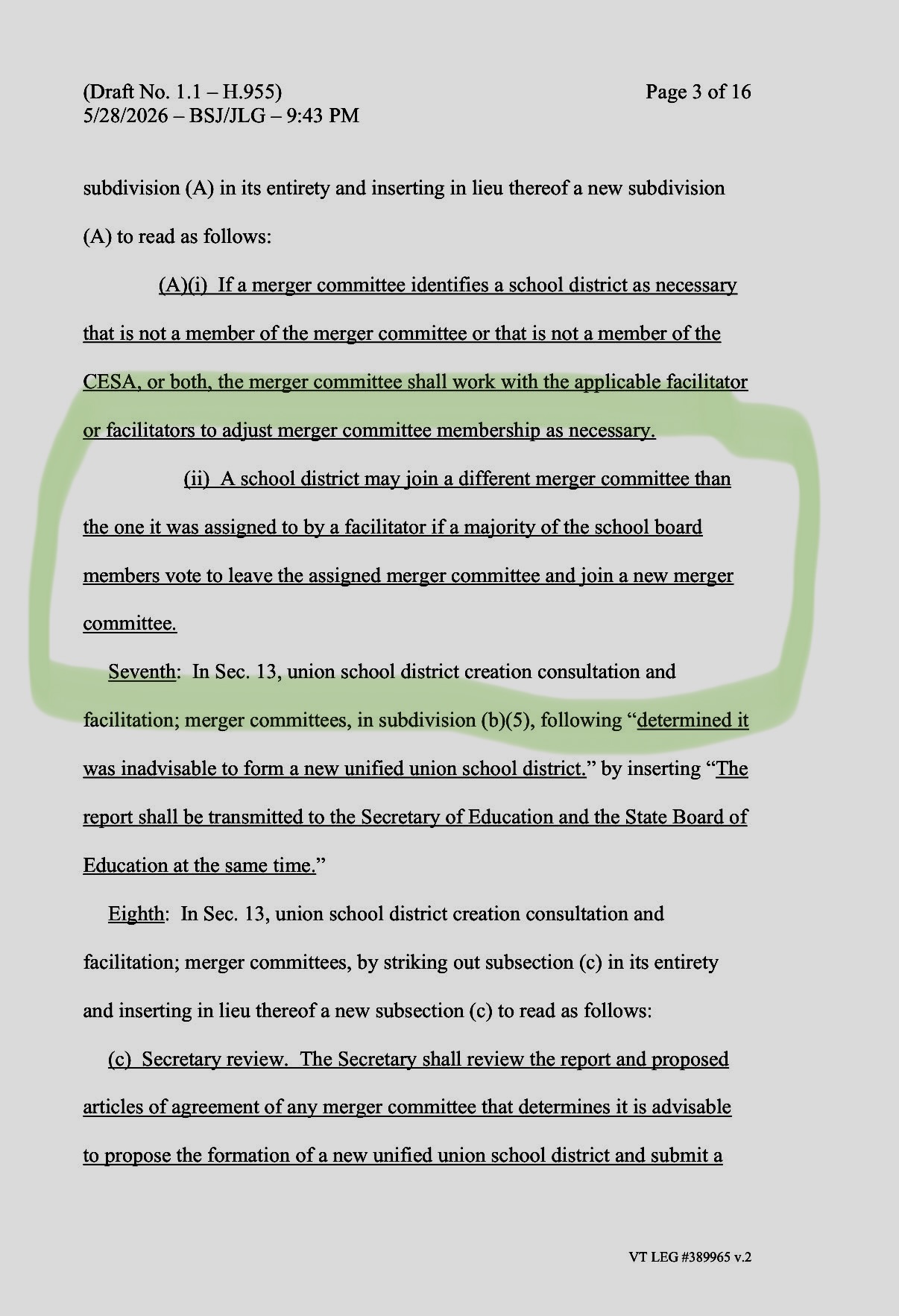
2. Can a school district move to a different merger committee?
Yes. H.955 expressly provides: “A school district may join a different merger committee than the one it was assigned to by a facilitator if a majority of the school board members vote to leave the assigned merger committee and join a new merger committee.” (Sec. 13(b)(4)(A)(ii))
- What is known: A school board may vote to move to a different merger committee.
- What is not known: The bill does not expressly state whether approval from the receiving merger committee, facilitator, Agency of Education, or State Board is required after that vote.
3. What is the timeline for the merger process?
The process begins during the 2026–2027 school year. Key deadlines include:
- School districts identify merger committee representatives by September 15, 2026.
- Merger committees begin meeting by October 15, 2026.
- Status reports are due February 1, 2027. (Sec. 13(f))
- Merger committee final reports and any proposed articles of agreement are due September 1, 2027. (Sec. 13(b)(5))
- State Board findings are due by December 15, 2027. (Sec. 13(d))
- If a merger committee recommends creation of a new unified union school district, voters will vote on that proposal on March 7, 2028. (Sec. 13(e))
4. Is a proposed merger voted on by towns or by the district as a whole?
H.955 says that: “The voters of each school district that is identified as necessary or advisable shall vote whether to form the proposed unified union school district…” (Sec. 13(e))
- What is known: Voters in each affected school district participate in the vote.
- What is not known: The exact voting mechanics for a particular proposal may depend on the articles of agreement and the existing statutes governing formation of unified union school districts under 16 V.S.A. §§ 706–710.
5. Can a town still petition to leave its current school district?
No, if the district is a union school district. H.955 establishes a moratorium through Fiscal Year 2035 on petitions to withdraw from or dissolve union school districts under 16 V.S.A. §§ 724 and 725.
6. Can a district maintain its current structure, such as K–6 operation, elementary tuitioning, secondary tuitioning, or full choice, after a merger?
H.955 does not itself eliminate tuitioning, school choice, K–6 operating districts, or nonoperating districts. However, if districts choose to propose forming a new unified union school district, the merger proposal would need to specify how the new district would provide education. That includes identifying which grades the district would operate directly and which grades, if any, would continue to be served through tuitioning. (16 V.S.A. § 708)
This is particularly important when districts with different structures are considering a merger. For example, one district may operate a K–12 school system, another may operate only elementary schools and tuition secondary students, and another may tuition students for all grades. A merger proposal would need to explain how those different arrangements would work in the newly created district.
- What is known: H.955 does not eliminate existing tuitioning or school choice systems.
- What is also known: A future merger proposal could change how education is provided in participating districts if the articles of agreement propose a different operating or tuitioning structure and voters approve it.
- What is not known: Whether a specific future merger proposal would preserve, modify, or replace existing K–6, K–12, elementary tuitioning, secondary tuitioning, or full-choice arrangements.
7. Can new districts form as Supervisory Unions, or must they be Unified Union School Districts?
The merger committee process established in H.955 is specifically focused on evaluating the creation of Unified Union School Districts. (Sec. 13)
- What is known: The merger committee process is designed around potential formation of Unified Union School Districts.
- What is not known: Whether other governance structures (like Supervisory Unions or Supervisory Districts) could emerge through separate processes under existing law or future legislation.
8. Can districts continue accepting tuitioned students from outside the district?
Nothing in H.955 prohibits districts or approved independent schools from continuing to accept publicly tuitioned students. The bill regulates tuition charges but does not prohibit districts from receiving tuitioned students. (Sec. 24)
- What is known: H.955 does not eliminate the practice of accepting publicly tuitioned students.
- What is not known: Whether future merger proposals could alter local enrollment practices or tuition arrangements.
9. If a district does not operate a public secondary school, can students still attend schools outside the district?
Under current law, yes. Nothing in H.955 repeals Vermont’s existing tuitioning authority for districts that do not operate a public secondary school. The bill preserves Vermont’s tuitioning framework and amends tuition regulation rather than eliminating tuitioning authority. (Sec. 24)
However, this question is closely related to Question 6.
If a future merger proposal creates a new unified union school district, the articles of agreement would need to specify which grades the new district will operate and which grades it will pay tuition for. (16 V.S.A. § 708)
If the newly created district does not operate a public secondary school, students could generally continue to be tuitioned to schools outside the district. If the newly created district does operate a public secondary school, the tuitioning arrangements could be different.
- What is known: H.955 does not itself eliminate tuitioning authority for districts that do not operate a public secondary school.
- What is not known: Whether any future merger proposal would preserve, modify, or replace existing secondary-school tuitioning arrangements.
10. What happens if a district does not merge? Are there penalties? Could districts under 750 students be forced to join another district?
H.955 does not force consolidation. Districts are required to participate in the merger committee process, and facilitators are directed to work with districts in ways that avoid leaving districts with fewer than 750 students isolated from potential governance solutions.
The bill also creates financial incentives tied to participation. Districts found not to have participated in good faith may become ineligible for certain legacy debt assistance programs. (Sec. 74)
- What is known: Participation in the merger committee process is required. The bill creates incentives and consequences related to participation.
- What is known: H.955 does not contain language automatically consolidating districts below 750 students.
- What is not known: Whether any future merger committee recommendations, local votes, State Board actions, or future legislation could result in additional governance changes.
One of the challenges with legislation this large is that not every operational question is answered directly in the bill text. Some questions will be resolved through existing law, some through State Board rulemaking, some through the work of merger committees themselves, and some may ultimately require future legislative action.
I think it is important to be candid about that reality. H.955 establishes a framework and a process that builds off of Act 73 on 2025, but many implementation decisions still lie ahead. I have been telling our school boards that this bill is not a destination, it is a road to a destination. This is really difficult and often emotional work. Please support your school boards by participating when you are able.
Education governance, educational opportunity, affordability, and property taxes are issues where reasonable people disagree about the best path forward. As these discussions continue, my goal is: ensuring that local voices are heard and that communities have meaningful opportunities to participate in decisions that affect their schools and their future.
I hope to see many of you at upcoming school board meetings, WRED meetings, and my expanded office hours throughout the district. As always, please do not hesitate to reach out with questions, concerns, or ideas.

Vermont Days
Vermont Days returns on June 13–14, offering free admission to Vermont State Parks and Vermont State Historic Sites statewide.
Enjoy free day-use access at Vermont’s state parks, free admission to historic sites and museums, and a variety of family-friendly activities taking place around the state throughout the weekend.
Saturday, June 13 is also Free Fishing Day, allowing both residents and nonresidents to fish in Vermont without a fishing license, although all fishing regulations still apply. Additional information, participating locations, and event schedules are available at:
If you need help with state services, please reach out. I do not have staff and I work year-round, so if you do not hear back in a day or two, please follow up or send a text. If you find my work useful and are able to support it, you can do that here.
Thank you for staying engaged and staying in touch!
Rep. Laura Sibilia
Windham-2 District (Dover, Jamaica, Somerset, Stratton, Wardsboro)
Email: lsibilia@leg.state.vt.us
Phone: (802) 384-0233
Discover more from Vermont State Representative Laura Sibilia
Subscribe to get the latest posts sent to your email.
 Vermont State Representative Laura Sibilia