
Dear friends and neighbors,
I hope this finds you well and that you are able to enjoy some of the early fall colors. This is one of my favorite times of year in Vermont.
Many of you have told me you are worried about rising political rhetoric and violence. This month, President Trump signed an order trying to classify Antifa as a domestic terrorist organization, though it is unclear if that is legally possible. Antifa, short for “anti-fascist,” is not a formal group but a loose movement.
Moments like this are a reminder that non-violence matters. Political violence from any direction weakens our democracy. Fascism concentrates power in one leader, silences dissent, and uses intimidation. Democracy is different, it depends on shared power, accountable leaders, and the right to speak, protest, and vote.
Vermont has a long tradition of civic participation, and peaceful protest is one way many make their voices heard. If you or your family attend a demonstration, remember the basics: stay on public property, bring water and medications, travel with a buddy, and above all remain peaceful and respectful. Violence jeopardizes both safety and purpose.
- Principles of Nonviolent Protest – The King Center
- Vermont Civic Education Resources
- ACLU of Vermont Protest Rights Guide
I’ll also be holding office hours on Saturday, October 4, from 11:00 am to noon at the Dover Free Library. Please stop by to share your thoughts or ask questions. These conversations are one of the ways we keep democracy strong here at home.
That same day, a free Community Health and Wellness Fair with take place at Brattleboro Union High School on Saturday, October 4, from 11 to 3. BMH is hosting this event in partnership with Grace Cottage, Senior Solutions Area Agency on Aging for Southeastern Vermont, Brooks Memorial Library, Brattleboro Retreat, Building A Positive Community, & Vermont Department of Health. This is a chance to connect with local providers, get free screenings, and learn about available resources.
Although Sheriff Mark Anderson’s most recent forum has passed, his proposal for a more regional model of policing is still being developed. I have spoken with him directly and appreciate his efforts to try to find ways to work across the county to increase law enforcement coverage and decrease costs. A proposal is expected to come before the Legislature in the upcoming session, and I will be paying attention to how it could impact our towns. Read more in the Reformer
Health insurance subsidies
About 30,000 Vermonters use Vermont Health Connect. The enhanced federal tax credits that have kept many plans affordable are set to expire at the end of 2025. If Congress does not extend them, many families will see sharp premium increases during 2026 enrollment. This is a top affordability concern for our district and our state.
Vaccine update
Governor Scott and the Department of Health have taken action to ensure COVID-19 vaccines remain available this fall. A standing order is now in place so that both pharmacies and primary care providers can continue administering the vaccine, as they have in past years.
This comes at a time when federal guidance has shifted and political rhetoric around vaccines has grown louder. Vaccines remain one of the best tools to prevent serious illness from COVID-19. Flu, RSV, and pneumonia vaccines are also widely available this season.
As always, your healthcare provider is the best source for medical advice. If you have questions about vaccines or other medications, please check in with them.
Electric rates: regulation, renewables, and data centers
I’m continuing to hear political rhetoric in our state about energy affordability. Have you ever wondered what drives Vermont’s electric rates? It’s pretty interesting and can also get complicated, but here are some basics that matter in our state:
- Vermont is regulated. The Public Utility Commission (PUC) reviews and approves utility rates. This oversight prevents the extreme spikes you see in deregulated states like Massachusetts, Connecticut, and New York.
- We are surrounded by deregulated states. When natural gas prices jump or supply is disrupted, our neighbors rates can soar. Vermonters are better protected because our utilities must serve all customers at approved, predictable rates.
- The Renewable Energy Standard (RES) requires utilities to steadily increase renewable energy in our supply. This does not just cut emissions, it helps stabilize rates long term by reducing dependence on volatile fossil fuels.
There are also new challenges related to pressure on electric rates. Across the country, AI data centers are driving unprecedented demand for electricity, much of it met with coal and natural gas. That raises concerns not just about climate impacts, but also about affordability if demand for electricity outpaces supply.
At the same time, nationally funded outside groups like Americans for Prosperity are active here in Vermont pushing a distorted message that renewable energy and the RES are to blame for higher costs. The reality is the opposite. It is our regulated system and growing use of renewable energy that keep Vermont’s rates steadier and lower than our neighbors.
Governor’s Executive Order on Housing
Governor Scott has signed Executive Order 06-25, which promotes housing construction and rehabilitation in Vermont. An executive order is a tool governors can use to direct state agencies in how they carry out existing laws. Unlike legislation, which must be debated and passed by the House and Senate, an executive order does not change state law, but it can set priorities and speed up work within state government.
The Governor says the order is meant to make it faster and less costly to build homes. Here are some of the changes:
- State agencies are instructed to speed up permitting for housing projects and cut down on delays.
- Some fees for housing permits can be reduced or delayed to ease costs for builders.
- In designated growth areas, rules around wetlands reviews are narrowed to make approvals simpler while keeping protections in place.
- Agencies must also look for unused state-owned land that could be converted into housing.
- Progress will be tracked with regular reports on permitting times, fees, and housing units built.
You can read the full order here: Executive Order 06-25 (PDF).
Act 181 and Tier 3
In earlier newsletters I have shared my concerns with Act 181, the 2024 land use law that creates the Land Use Review Board and new Tier 1, 2, and 3 maps across Vermont. Tier 3 lands, the most rural and environmentally sensitive, will face automatic Act 250 review for any new development, no matter the size.
Right now, the state is working on the rules for those maps. I continue to be concerned that this is happening without first ensuring fairness and transparency for the Vermonters whose land will be most affected.
In October, the Rural Caucus has scheduled two meetings to focus on these issues. I am working with colleagues from all parties and independents, as well as developers, environmental advocates, and good government groups, to develop proposals that respect landowners, offer transparency, and balance environmental protections with fairness.
Next Year’s Budget
At the September 18th meeting of the Legislature’s Joint Fiscal Committee, members heard an update on Vermont’s finances. The good news is that the state’s General Fund reserves remain strong, which provides stability as next year’s budget is being developed.
The picture is not as steady for our Transportation Fund, which pays for roads, bridges, and public transit. That fund is tighter and has already led to cuts at the Agency of Transportation.
The biggest unknown is federal funding. Vermont relies heavily on federal dollars for healthcare, food assistance, and home heating programs. If those funds are reduced or delayed in Washington, many Vermonters will feel the impact directly.
School Redistricting Task Force Update
The Legislature’s School Redistricting Task Force continues its work under Act 73. At the September 10 meeting, members stressed that building credibility will require a transparent process, clear criteria, and real public engagement.
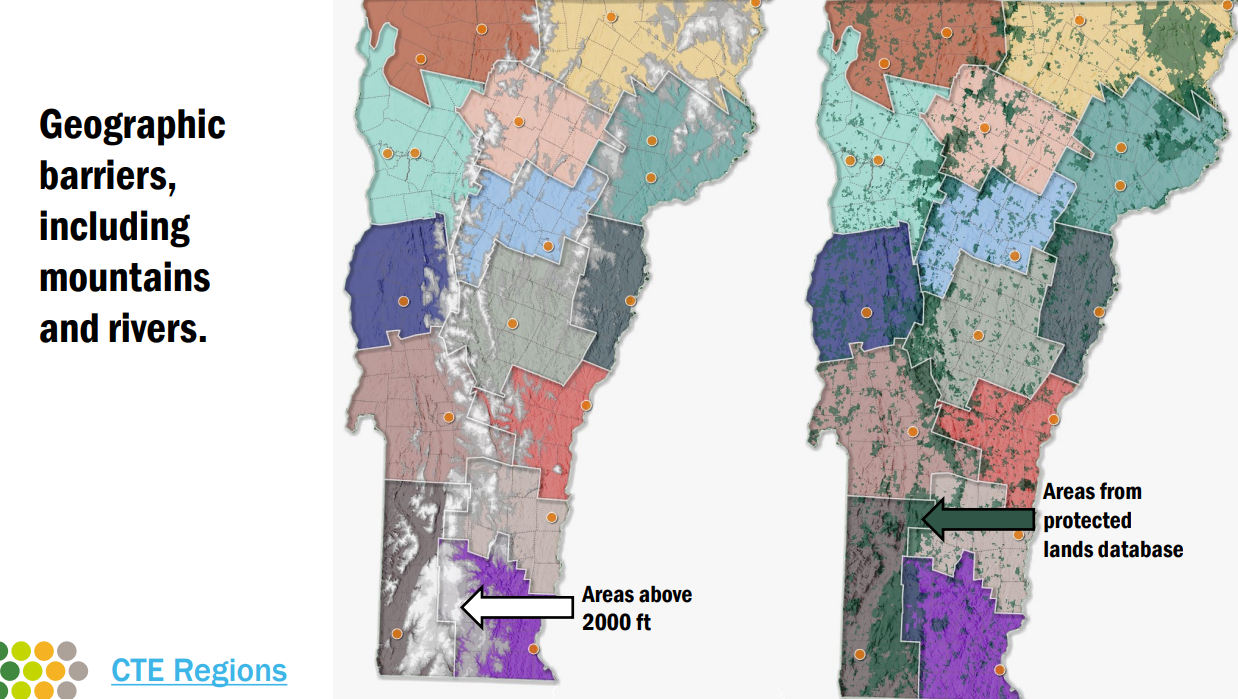
Mapping efforts are also underway. Some scenarios use Career and Technical Education (CTE) regions (photo above) as potential district boundaries. Others draw from BOCES models or transportation data.
I’m pleased to see that the Task Force is looking at geographic barriers like mountains, rivers, and areas above 2,000 feet. These factors matter a great deal in districts like ours and other rural, mountainous communities, but too often get overlooked in state-level planning.
Follow Task Force materials and mapping tools here:
Newly released climate adaptation strategy for Vermont
Vermont has just released the Resilience Implementation Strategy, a plan that pulls together practical steps to help our communities prepare for flooding, heat, and other climate impacts. That means stronger culverts and bridges, a permanent fund to help towns reduce flood risk, better dam safety, and clear guidance for homeowners and farmers. These are projects that can save both lives and money. Every dollar we invest in resilience now can save many more in future disaster costs.
To learn more, attend a virtual public meeting on October 23 or 27 or visit the Resilience Implementation Strategy webpage at https://climatechange.vermont.gov/resilience-strategy/overview.
The Treasurer’s Office estimates that carrying out the strategy will take about $270 million in one-time funding and $95 million in ongoing yearly costs. Those numbers are significant, and figuring out how to pay for this work will be a challenge for us all. Vermont is facing billions in damages from floods, storms, and other climate impacts, and the first step to being able to deal with that is having a plan, so I appreciate the work done by the Governor and Treasurer to pull this one together.
Vermont’s Climate Action Plan, required by the Global Warming Solutions Act, is about cutting the pollution that causes climate change and helping Vermont’s economy align with the global transition to cleaner energy. The newly released Resilience Strategy is different. It is about preparing for and dealing with the damage we are already seeingfrom floods, storms, heat, and drought.
These are two different strategies, but they work together. One reduces emissions and aligns our economy with the global energy transition. The other helps our communities cope with the impacts already here. We need both if we want our families, businesses, and towns to weather the challenges ahead.
At the same time, Vermont has also joined other states in suing Big Oil to hold them accountable for the billions in damages caused by climate change. That effort is about making sure the companies that profited from causing the harm also help pay for the costs of protecting our communities.
In July 1977, Exxon’s own senior scientist James Black told the company that ‘there is general scientific agreement that the most likely manner in which mankind is influencing the global climate is through carbon dioxide release from the burning of fossil fuels.’
—ScientificAmerican.com, “Exxon Knew About Climate Change Almost 40 Years Ago”
People vs. Big Tech Town Halls
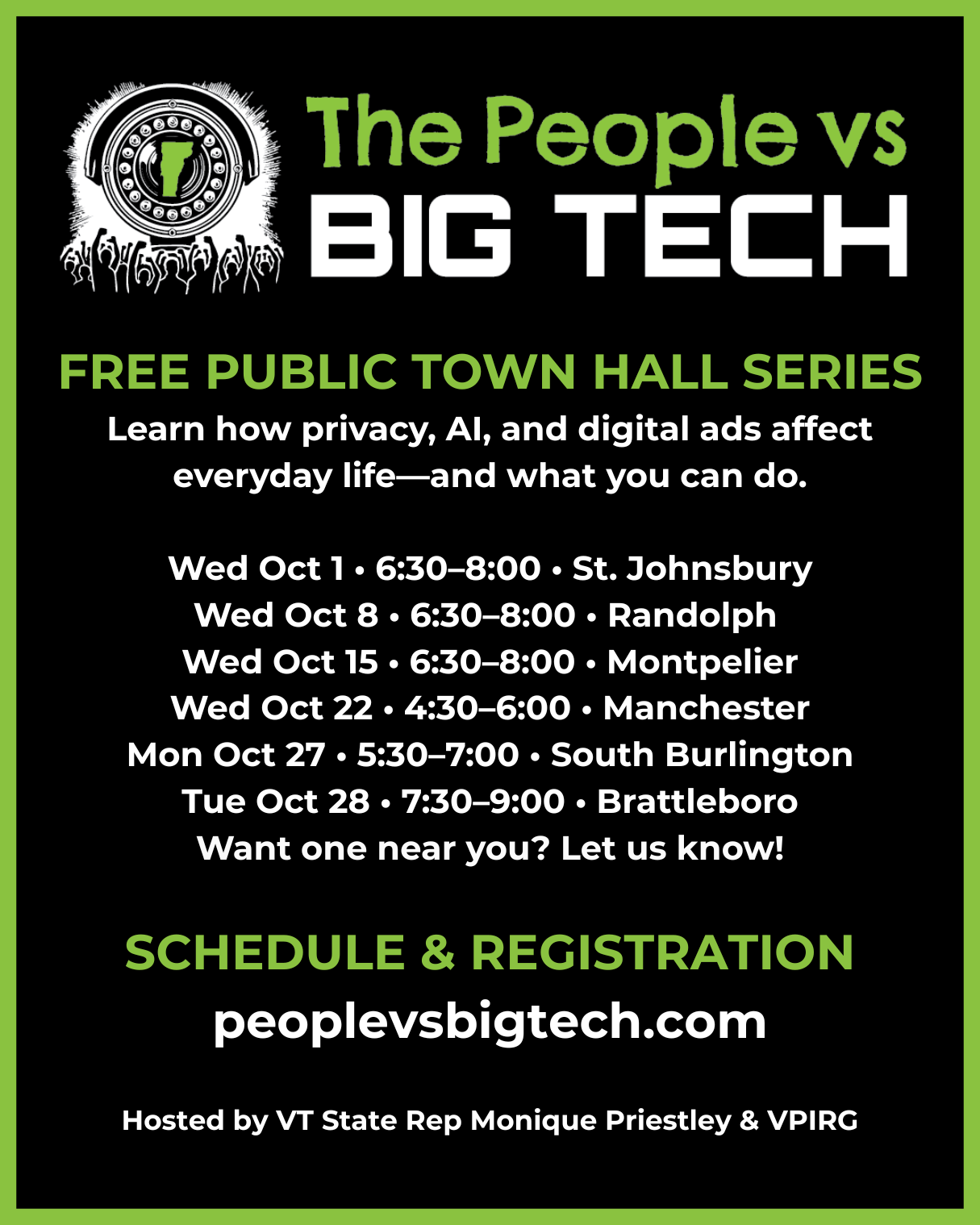
A new statewide series, People vs. Big Tech: Vermont, is bringing free, public conversations on privacy, AI, and digital power to communities across Vermont. Events include expert briefings, audience dialogue, and steps Vermonters can take to protect themselves while pushing for smarter, people-first policy.
- Manchester – Wed. Oct. 22, 4:30–6:00pm, Community Library
- Brattleboro – Tue. Oct. 28, 7:30–9:00pm, Brooks Memorial Library
I will be at the Brattleboro event, please join me there. Register and learn more at peoplevsbigtech.com
Upcoming Office Hours
- Dover: Saturday, October 4, 11 to noon, Dover Free Library
- Wardsboro: Thursday, October 16, 6 to 7 pm, Wardsboro Library
I know many of you are worried about what is happening nationally with free speech and press freedoms. We are not powerless in the face of those concerns. Here in Vermont, we can take action by supporting our local papers, public radio, and community news outlets. A digital subscription to the paper of your choice often costs about ten dollars a month and makes a real difference in keeping local journalism strong and independent. If you are able, consider a digital subscription to a local or independently owned paper.
Reach me anytime at lsibilia@leg.state.vt.us or (802) 384-0233. If you are able, I appreciate you supporting my work.
— Rep. Laura Sibilia
Windham-2 District (Dover, Jamaica, Somerset, Stratton, Wardsboro)

Discover more from Vermont State Representative Laura Sibilia
Subscribe to get the latest posts sent to your email.
 Vermont State Representative Laura Sibilia