
Friends and neighbors,
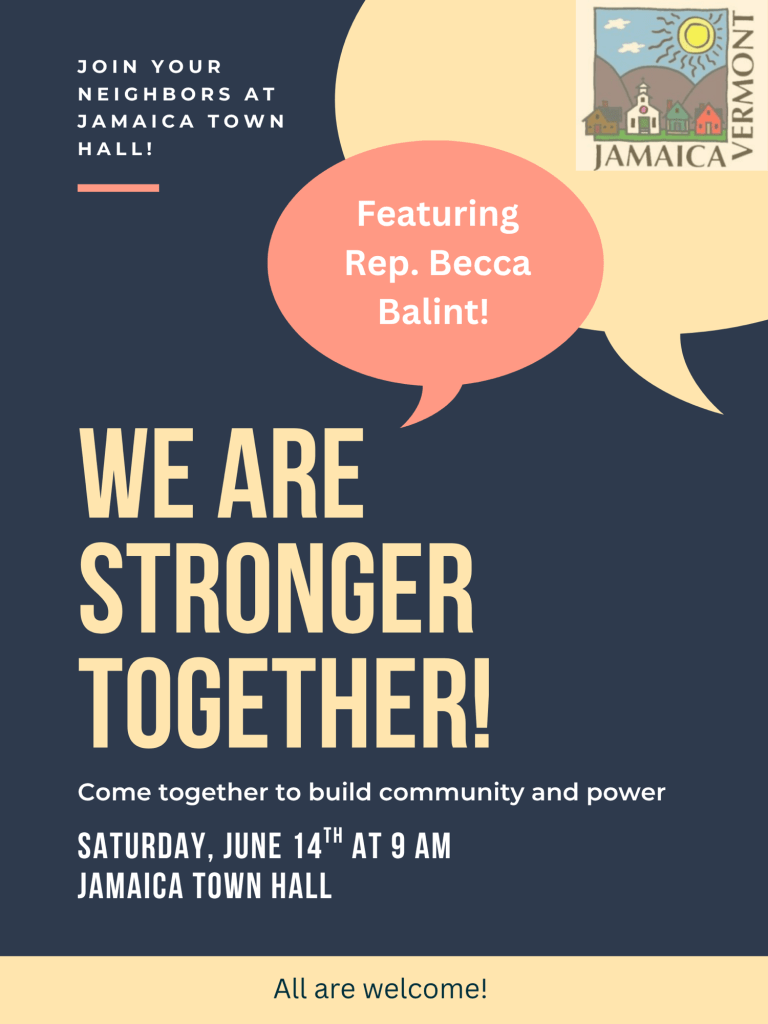
Join me tomorrow in Jamaica at 9 am to hear from our Congresswoman Becca Balint. My next ofice hours will be Thursday June 17th at 6 pm iat the Wardsboro Library.
Peaceful protest in protected by the Constituion. Here is information to stay safe: Protecting yourself when protesting, Know Your Rights: What to Do if You or a Loved One is Detained
The Legislature was supposed to adjourn two weeks ago. We left at midnight without agreement, and we’ll return on Monday June 16th to take up what could become the most significant education reform legislation in a decade. These reforms, if passed, wouldn’t fully take effect for several years, but they would shape how schools are governed and funded across Vermont for generations.
The goal is to build a more sustainable system that delivers quality and equity in the face of declining enrollment, rising costs, and widening inequality across districts. But the process has been complex and strained.
The current reform proposal in H.454 would make major changes to both funding and governance. It would shift back to a state-controlled funding model, called a foundation formula, and a consolidation of supervisory unions and school boards into fewer, larger regional entities (cosolidation of boards, not buildings).
The idea is to contain costs, equalize opportunity, and relieve pressure on local property taxes. But their are risks including unintended tax increases, future school closures, and uncertain benefits for students.
I support modernizing governance and pursuing cost containment in ways that are fair. But we need to be clear about what that really means for the students in our rural schools and what our taxpayers will see as a result.
A recent article from Vermont Public highlights deep divisions among lawmakers. Many who initially supported reform are now expressing concern. There’s confusion over how tax changes will play out, frustration about last-minute carve-outs for private schools, and growing alarm that the bill might shift control away from local communities without improving student outcomes.
This is a pattern I have seen play out over and over again with big education policy reform proposals. It’s important to remember that legislation is passed by a majority of members which is 76 in the House and 16 in the Senate – of any party.
As I noted when we temporarily adjourned, we should not try to do everything all at once. I urged my colleagues and the administration to slow down and start where there is the most consensus. Layering major funding changes, governance consolidation, and structural shifts into a single bill – an all or nthing proposal – could easily backfire.
Over the past two days, the Committee of Conference has been meeting to negotiate a final deal. It seems to me that much of the discussion has focused on the Senate’s efforts to protect access to public dollars for private and religious schools. This is a major sticking point, especially for ensuring equitable access to educational opportuity for all students, and addressing the current constituioonal problem we have with the town tuitiiooning program. You can watch or review each of those meetings at the links below.
Meanwhile, the Commission on the Future of Public Education, created by the Legislature to provide a public process and long-term guidance, remains largely sidelined. In a recent VTDigger article, commission members shared their frustration about being bypassed. Without space for sustained public engagement and long-term oversight, reform efforts are top-down mandates that will be difficult to sustain support for.
On Monday, we’ll return to Montpelier to vote. It’s still unclear what the final bill will look like – the Committee of Conference edits are being posted here: When deciding how to vote, I’ll be focusing on:
- Accountability for public dollars
- Transparent processes for public input moving forward
- Likliehood to improve quality throughout the state
- Tax impacts
Thank you to everyone who’s reached out. Please keep sharing your questions, concerns, and ideas about what a stronger, fairer education system should look like in Vermont.
More soon,
Laura
- H.454 CoC – 2025-06-13 – 3:20PM
- H.454 CoC – 2025-06-13 – 9:50AM
- H.454 CoC – 2025-06-12 – 7:45PM
- H.454 CoC – 2025-06-12 – 5:10PM
- H.454 CoC – 2025-06-12 – 2:00PM
- H.454 CoC – 2025-06-12 – 11:00AM
- H.454 Committee of Conference – 2025-06-11 – 4:00PM
- H.454 Committee of Conference – 2025-06-11 – 1:00PM
- H.454 Committee of Conference – 2025-06-11 – 10:00AM
Utility Valuation Changes Impact Local Towns
Friends and neighbors,
As part of a multi-year effort led by the House Ways and Means Committee to bring consistency to property valuations, the Vermont Tax Department has implemented a new process for assessing electric utility infrastructure. While the overall effect statewide is a 7.4% increase in utility valuations, the impact varies significantly by town.
In our district, three of four towns saw significant drops in value:
- Dover: down $2.9 million (−14.7%)
- Wardsboro: down $539,732 (−10.6%)
- Jamaica: up $1.38 million (+9.5%)
- Stratton: down $1.96 million (−23.6%)
This shift reflects a move away from assessing based on local infrastructure toward a formula that allocates statewide utility value based on customer counts. That change has raised concerns in smaller rural communities, where fewer customers can mean a smaller share of taxable value.
More background in this recent VTDigger article:
New process for taxing utilities prompts confusion in some town
Official information from the Vermont Department of Taxes:
And here is the full town-by-town breakdown from the Tax Department
During the 2025 legislative session from January through May I will continue to meet on the 1st Saturday of the month at the Dover Free Library from 11-noon and at your group’s invitation as schedules allow. Monitor my votes and the bills I am sponsoring at: https://legislature.vermont.gov/people/single/2026/24023 As always, if you have suggestions, concerns or critiques please be in touch so we can schedule one on one time to discuss. Please do not hesitate to contact me if you need assistance navigating government services at (802) 384-0233 or lsibilia@leg.state.vt.us. Follow my regular posts online at http://www.laurasibiliavt.com

Discover more from Vermont State Representative Laura Sibilia
Subscribe to get the latest posts sent to your email.
 Vermont State Representative Laura Sibilia
Thanks for your commitment to our communities.
I am concerned about the loss of local school communities and the failure to meet the needs of children based on the education bill. Consolidation costs money and comes at a loss to the children and families.
Years ago it was thought that single payer health care could help to limit the cost of education. Tax payers pay for state government workers and then again to local town employers as well. Something to think about!