Friends and neighbors,
We are now in Week 7 of the 2026 legislative session, and this is the point in the session when it starts to become clearer which proposals are more likely to move then others. I’ve been hearing from many of you about a very wide range of issues including education reform, nuclear policy, herbicide applications, regional proposals, public safety pilots, and how major land-use changes under Act 181 are taking shape on the ground. I want to thank you for sharing what you are worried about or seeing as possible opportunities for our state – government works best when we are talking to one another.
This week’s update hopefully helps to add some clarity. Below you’ll find updates on bills that have been introduced, proposals that are being talked about but are not advancing, and several upcoming hearings and meetings where your questions and input matter.
Education Updates
Before getting into the details below, I want to acknowledge the moment we’re in.
I appreciate the space the Governor and the Speaker are holding for serious education governance reform. That was visible this this week in the materials shared by the Speaker with the full House and the encouragement that members engage.
I’m also hearing real concern about multiple different priorities from my legislative colleagues. Parents, educators, taxpayers, and local officials are worried about school closures, changes to school choice, designation decisions, and whether reform will actually deliver meaningful property tax relief. Those concerns must be taken seriously.
They also cannot become the reason we fail to act. Our education system is already changing around us. Choosing not to engage now will leave communities with fewer options and harder decisions later.
I agree with the Speaker’s encouragement to lean in. There are many perspectives in this work, and that is expected. We cannot let that reality become an excuse for inaction. Let’s keep talking and looking for ways to bridge gaps
Robert Frost, who spent many years writing in Vermont, once observed, “Education is the ability to listen to almost anything without losing your temper or your self-confidence.”.
The following presentations were shared to the whole House by the Speaker with encouragement to “lean in” on education transformation discussions. There is some helpful baseline information here.
Presentations in House Education and Ways & Means
- Education Governance 101 – Legislative Counsel
- Preliminary report on School Board approved, pre-Town Meeting Day, School District budgets – Agency of Education
- Education Fund Growth (including future year projections) – Joint Fiscal Office
A second map appears…
WCAX Vermont Senate considers new school redistricting map
This week, a new map was introduced in the Senate by the Chair of Senate Education Seth Bongartz, the former long-time chair of the Burr and Burton Academy board, offering an alternative approach to the “Conlon map”. In this proposal, Dover, Wardsboro, and Stratton are together in a Bennington region, while Jamaica is in a separate Windham region grouping to the north. This map aligns many Burr and Burton so called “sending” towns within Burr and Burton’s orbit. By contrast, the earlier Conlon map keeps Jamaica, Wardsboro, Stratton, and Dover in a single Windham-centered region. Statewide, the Bongartz map more often prioritizes aligning regions around choice, while the Conlon map more consistently prioritizes county geography, highlighting one of several core differences of opinion about how regional lines should be drawn.
Maps below from left to right: House, Senate, elevation map.
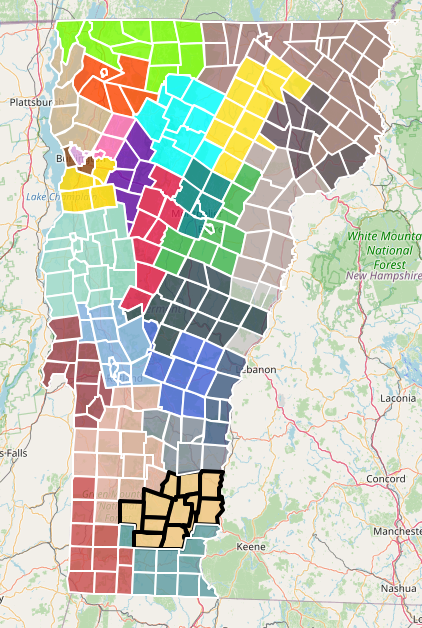
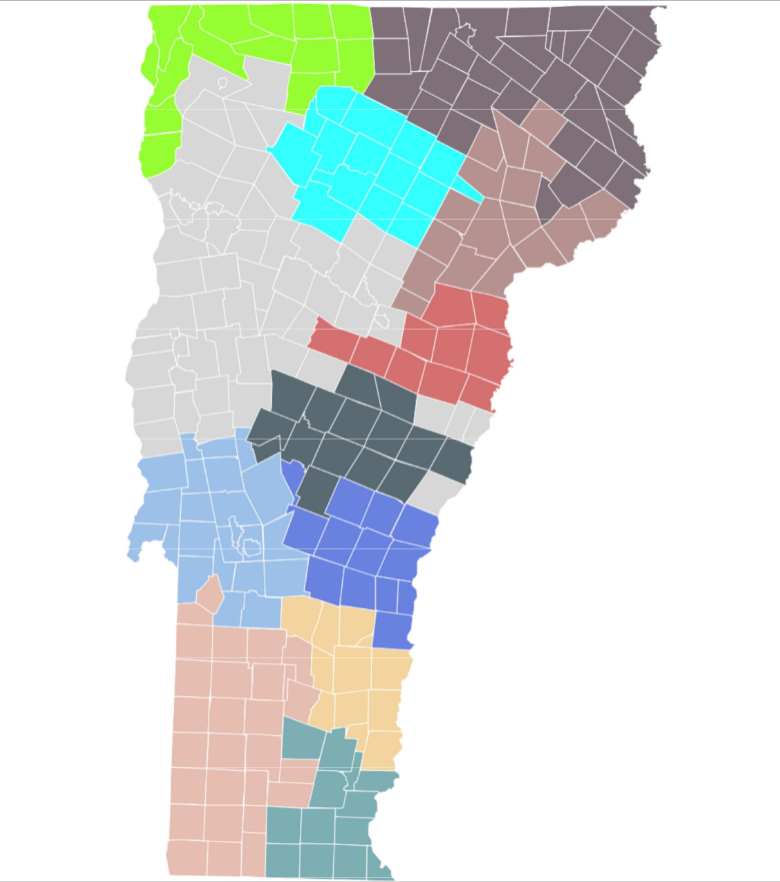
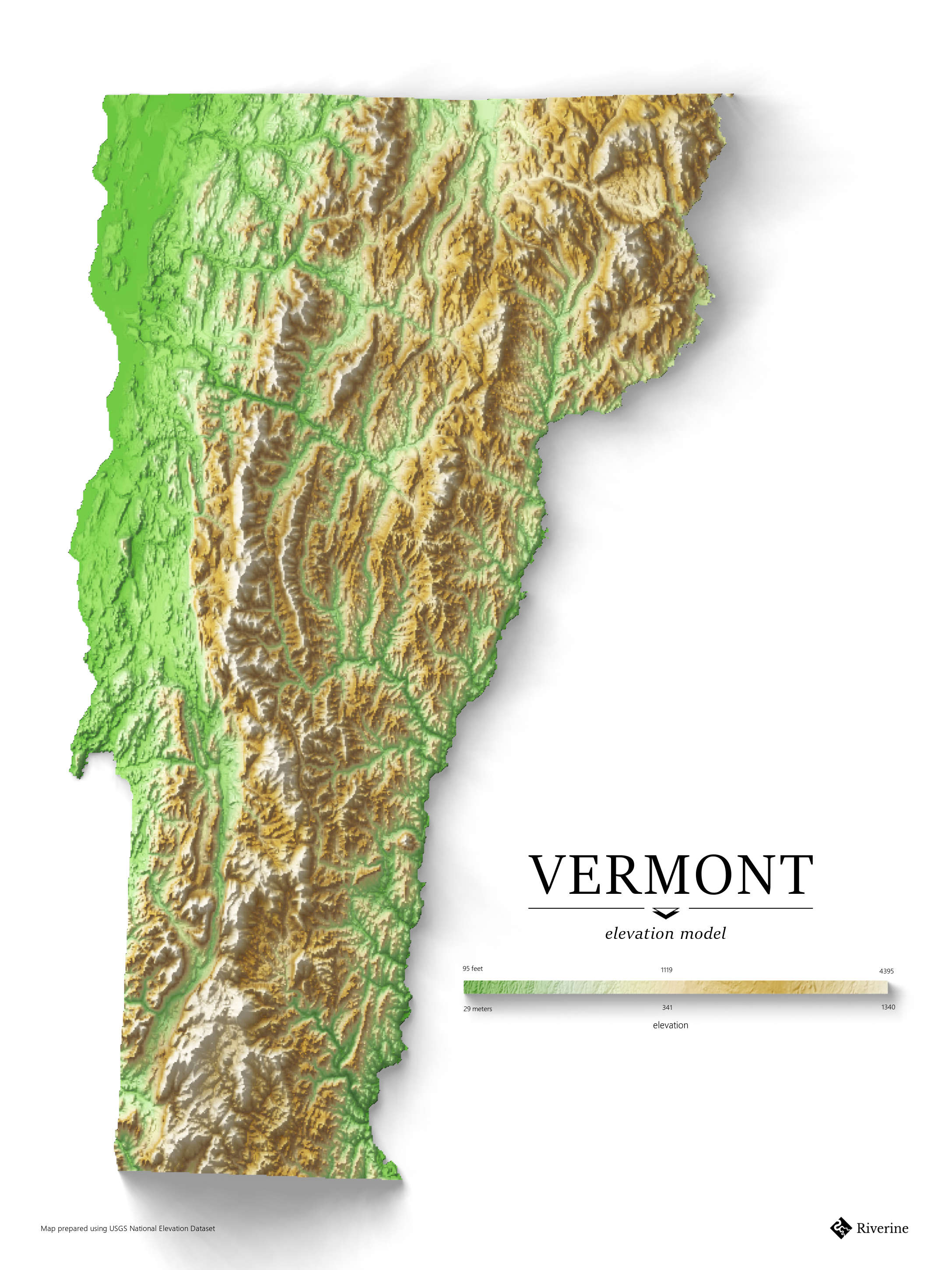
Additional note: Deerfield Valley folks may also notice that, like in the 2022 reapportionment, both House and Senate maps place Readsboro and Stamford students in Bennington County – despite no Vermont roads, only our beautiful Green Mountains – between those towns and Bennington.
Nuclear power
I’ve heard from folks with questions about nuclear policy and a proposal introduced this session. It’s important to be clear about what is and isn’t happening.
H.601 is the Governor’s proposal, and it proposes to allow the long term nuclear power contracts that our electric utilities currently have toward a clean energy standard instead of the 100% renewable energy standard we currently have. I support this. In addition it changes some permissions for storage of nuclear waste on the VY site. I have major questions regarding this. Regardless, I have been assured that this bill is not moving forward this session. There is no active push to advance it, and it is not scheduled for action. Existing oversight and legal frameworks remain in place, and any change to nuclear policy requires legislative review.
I am paying attention to energy issues. A reminder that I currently serve on the House Energy and Digital Infrastructure Committee where the bill is, the Nuclear Decommissioning Citizens Advisory Panel (NDCAP) connected to the decommissioning of the VY site, and on the National Conference of State Legislatures (NCSL) Energy Committee. Those roles keep me connected to both Vermont-specific oversight and broader national energy policy discussions.
Vermont Public: ‘County Meeting Day’? Rethinking regional government in Vermont
Regional Public Safety Pilot in Windham County
There is a voluntary regional policing proposal by the Windham County Sheriff which is structured as an opt-in pilot with regional representation. If passed, towns will choose whether to participate, and participating communities will each be represented by a local selectboard member on a regional council responsible for setting budgets, defining services, and evaluating performance. The value of a pilot like this is what it helps us learn: whether a regional governance model can deliver better service, better coordination, and more efficient use of public safety resources for the towns that opt in. If it moves forward, the success of the pilot should be measured by the quality of information it produces to guide future decisions, not just whether it operates. If this proposal advances out of committee, I will share more details
School Construction Costs and Education Spending
The Legislature has introduced H.750, a bill focused on how school construction projects are treated during the current moratorium on State construction aid.
The bill does two main things. First, it proposes excluding capital construction costs from the definition of “education spending” when the state calculates whether a district has exceeded its spending threshold. In practical terms, this would prevent voter-approved school construction projects from driving up education spending penalties for districts, particularly through the excess spending calculation.
Second, H.750 addresses the gap created by the moratorium on State Aid for School Construction. It would automatically consider any school district that begins construction before July 1, 2026, to have “good cause” for starting work before final state approval. This is intended to give districts clarity and protection if they move forward with necessary projects while the aid program is paused and being restructured.
The excess spending provision would take effect immediately if passed, while the construction approval provision would take effect on July 1, 2026. The bill is currently in Ways & Means.
Public Hearing on proposed changes to the Department of Motor Vehicles’ Inspection Manual and S.211
The Vermont Senate Committee on Transportation will hold a public hearing on February 24 from 5:00 p.m. to 7:00 p.m. in Room 10 of the State House. Interested parties may attend the hearing in person or virtually.
The Committee will take testimony on the proposed changes to the Department of Motor Vehicles’ Inspection Manual and S.211, a bill that proposes to require that motor vehicles be inspected every two years. Proposed changes to the Inspection Manual can be reviewed on the Committee’s website. Anyone interested in testifying must sign up in advance of the hearing through the following online form no later than 5:00 p.m. on February 18. For those planning to testify, instructions on how to access and participate in the hearing will be sent the morning of the hearing.
- Online sign-up form: https://legislature.vermont.gov/s211-public-hearing
- For those not planning to testify, the hearing will be available to watch live on YouTube at the following link: https://legislature.vermont.gov/committee/streaming/senate-transportation.
- Written testimony is encouraged and can be submitted through email at testimony@leg.state.vt.us or mailed to the Senate Committee on Transportation, c/o Megan Cannella, 115 State Street, Montpelier, VT 05633. For more information about the format of this event, contact Megan Cannella at Megan.Cannella@vtleg.gov
Public Meeting on Act 250 Tier 3 and Road Rule Jurisdiction Changes
The Windham Regional Commission will host a virtual public meeting on Tuesday, March 17 at 6:00 p.m. focused on the Act 250 Tier 3 and Road Construction Jurisdiction rulemaking currently being completed by the Land Use Review Board.
Alex Weinhagen, a member of the Land Use Review Board, will present on the current draft rules and Tier 3 mapping and will be available to answer questions from the public.
This meeting is an opportunity for towns, landowners, and community members to learn more about how Act 181 is being implemented and what the proposed changes could mean on the ground.
Zoom Meeting details
- Date: Tuesday, March 17 | 6:00 p.m.
- Zoom link: https://us02web.zoom.us/j/86212351800?pwd=HdTHqFDXbYlHPHBJcDurLJ6vQd4RaT.1
- Meeting ID: 862 1235 1800 Passcode: 565316 Dial-in: (301) 715-8592
Additional background information is available on the Windham Regional Commission’s Act 181 and Regional Plan Update webpage: https://windhamregional.org/act-181/. Please feel free to share this meeting information with others in your community who may be interested.
Health Care Forum
When: Saturday, February 21 | 11:00 a.m.–12:30 p.m.
Where: Bennington Firehouse
Join Senators Seth Bongartz and Rob Plunkett, with Sen. Ginny Lyons (Chair, Senate Health & Welfare Committee), for a public discussion on rising health care costs, quality of care, and what Vermonters can afford.
Panelists include Kayla Davis (Battenkill Valley Health Center) and Estevan Garcia (Southwest Vermont Medical Center), bringing local perspective to the conversation. All are welcome.
Jamaica State Park Public Scoping Meeting
The Vermont Agency of Natural Resources is beginning work on a new long-range management plan (LRMP) for Jamaica State Park and is inviting public input.
When: Wednesday, March 4, 2026 | 6:00–8:00 p.m.
Where: Townshend Town Hall, 2006 VT-30, Townshend
This meeting kicks off a month-long public comment period (open through April 3, 2026) and is an opportunity to learn about the park and share feedback on future management priorities. The plan will guide land management for the next 20 years, balancing recreation, conservation, wildlife habitat, and cultural history.
The LRMP covers the full park, including the Hamilton Falls Natural Area, but does not revisit site-specific visitor management at Hamilton Falls, which was addressed through a separate master planning process.
The meeting is open to the public and all are welcome to attend. RSVPs are appreciated but not required and can be sent through the Jamaica State Park website.
A recording of the meeting and a project StoryMap, an interactive webpage with maps, background information, and planning materials, will be available online. Public comments may be submitted in writing at the meeting, by email to anr.statelandsplanning@vermont.gov, or through a comment form that will be posted on the Jamaica State Park website after the public meeting.
As always, please reach out if you need help navigating state services or want to share what you’re seeing locally. I read and value your notes, even if I can’t always respond immediately. I do not have staff and I work year-round, so if you do not hear back in a day or two, please follow up or send a text. If you find my work useful and are able to support it, you can do that here.
Thank you for staying engaged and staying in touch!
Rep. Laura Sibilia
Windham-2 District (Dover, Jamaica, Somerset, Stratton, Wardsboro)
Email: lsibilia@leg.state.vt.us
Phone: (802) 384-0233
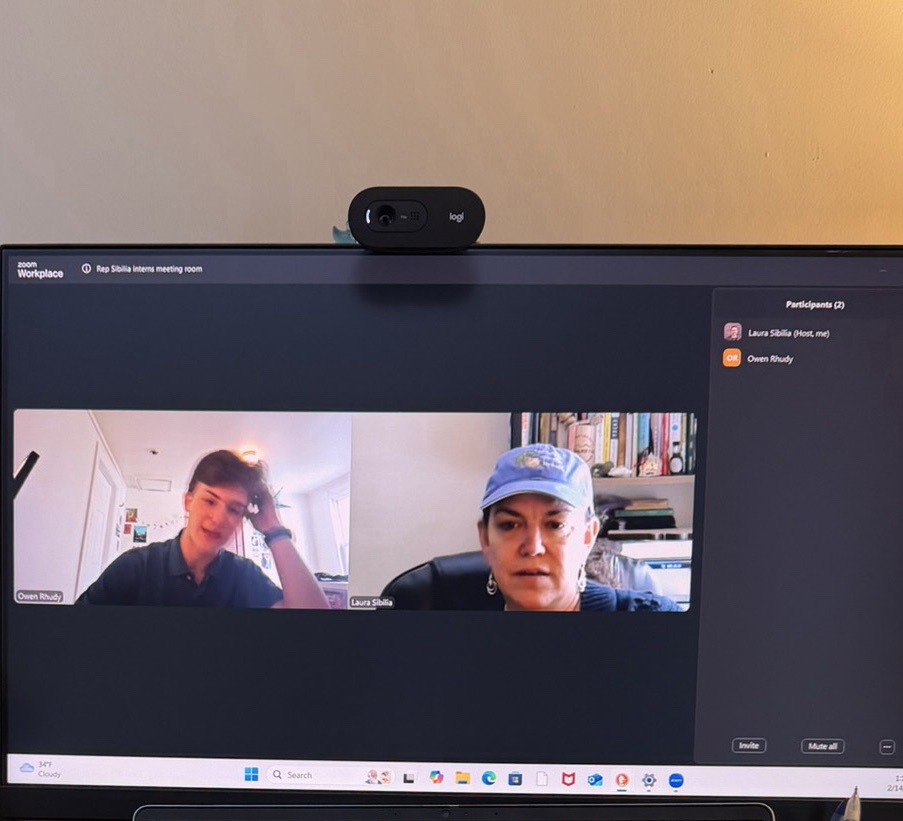
On Saturdays, back in Dover, I catch up with my interns on the issues they have been tracking for me.
Discover more from Vermont State Representative Laura Sibilia
Subscribe to get the latest posts sent to your email.
 Vermont State Representative Laura Sibilia