Friends and neighbors,
Congratulations to Jessie Diggins and Ben Ogden, both Stratton Mountain School alumni, on earning Olympic medals in Italy. It’s always thrilling to see Vermonters succeed at the Olympics stage.
The legislative session is now about one-third of the way through, and more bills are beginning to reach the House floor for debate. This week, I reported two telecommunications-related bills to the House.
A reminder that on Saturday, February 14, I will be hosting rescheduled office hours at the Dover Free Library from 11:00 a.m. to noon.
Act 250 and getting the sequence right
This week, the Senate took up and advanced changes related to Act 250 that respond to timing and process concerns raised by landowners, towns, and regions. As Act 250 expands in scope under Act 181 of 2024, it is imperative that the system delivers greater predictability, transparency, and consistent due process.
I’ve been working with legislative colleagues in the Rural Caucus and with organizations across sectors including business, municipalities, working lands, and environmental groups to focus on getting the timing right as these changes take effect. That work included testifying this week in a joint Senate hearing on Act 181 extensions alongside regional planners, municipalities, and statewide organizations, with a clear focus on aligning implementation timelines with the realities communities are facing on the ground.
Act 181 is often described as a housing bill, and housing is a central goal. But it is also a major conservation and climate-driven expansion of land-use regulation into rural Vermont. That expansion carries real, new obligations for the Vermonters who live on and care for that land. If we want these changes to succeed environmentally AND politically we have to be honest about what is being asked.
Climate change demands stronger land-use protections, and many Vermonters understand that imperative. But addressing that means the state needs to show up in concrete ways. That means clear guidance, technical and financial assistance, and practical support for landowners who want to improve their property, build for family, or responsibly subdivide land, who may now face significant engineering and mitigation requirements as part of that process.
Pairing expanded regulation with real support is not optional. It is how we achieve lasting environmental outcomes, protect housing, and maintain public trust. This week the Senate took meaningful steps in that direction.
For those looking for more background, VTDigger published a helpful overview of where the Act 250 overhaul stands and why questions about balance and implementation timing are coming into focus.
(Link: “As Act 250 overhaul takes shape, some question whether it strikes the right balance”)
I’ll continue working to ensure implementation protects housing, respects property rights, and gives communities clear, workable rules they can rely on.
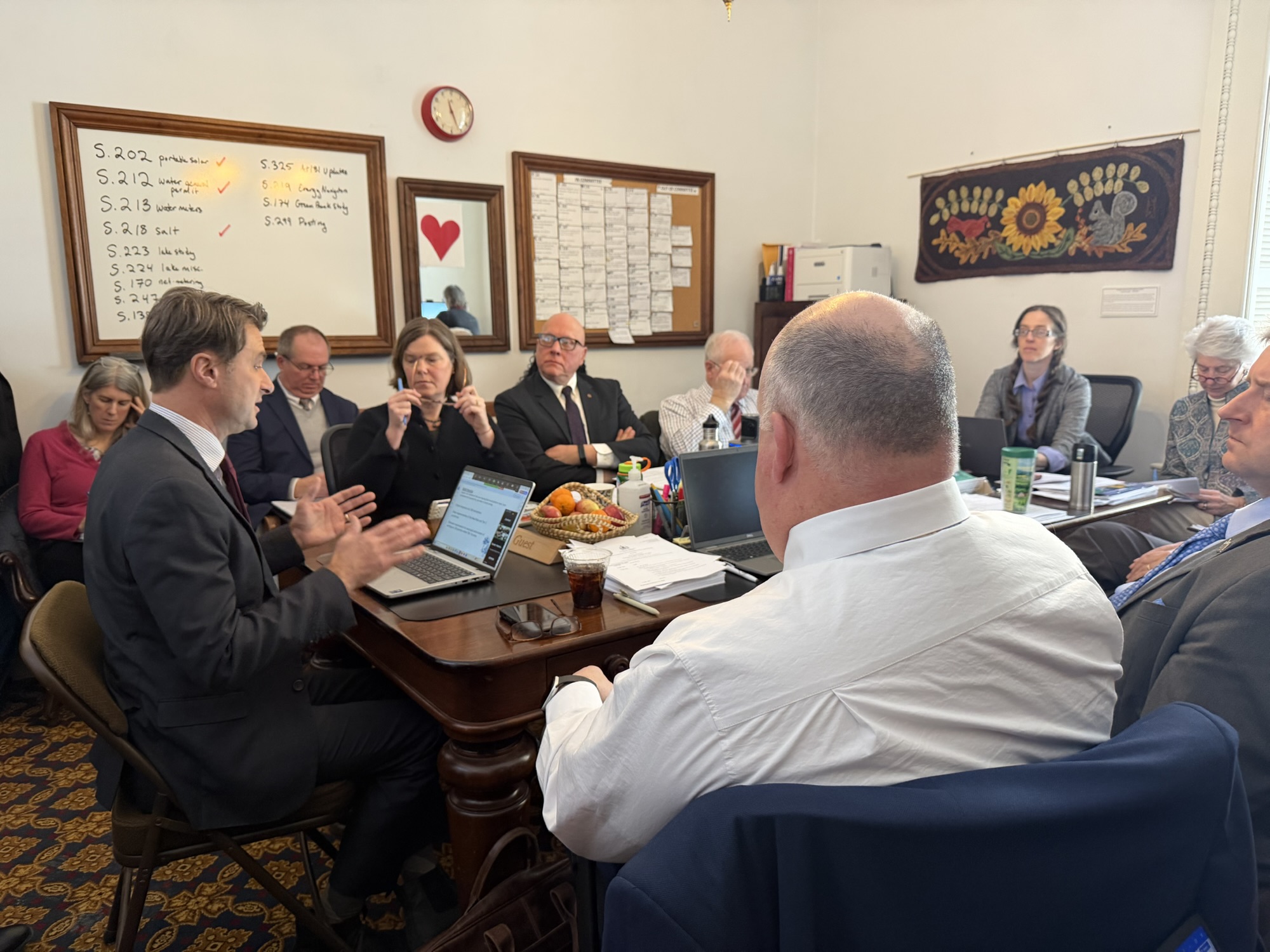
This week, our committee voted out two bills related to telecommunications which I reported to the full House.
Cell tower siting
The first, H.527, extends the sunset of 30 V.S.A. § 248a, which governs cell tower siting in Vermont. The bill passed out of committee on a 5–3–1 vote, and I will be reporting it to the full House next week.
Some members wanted to pursue a comprehensive rewrite of the statute this session. Given time constraints, and knowing the Senate is also considering changes to the sunset, I supported moving the bill forward rather than allowing it to lapse. If the sunset expires, cell tower siting would default to Act 250. Extending the sunset keeps a dedicated, statewide siting process in place while the Legislature and stakeholders continue work on improving notice, transparency, and public participation.
Network transition notice
We also voted out a bill focused on notice during telecommunications network transitions, H.898, particularly the shift from copper-based phone service to fiber-based networks we are seeing from Consolidated/Fidium. The bill passed out of committee on an 8–0–1 vote.
During testimony, the Department of Public Service indicated it will recommend that the Public Utility Commission review notice practices related to federally regulated copper-to-fiber transitions. We also heard from Jacksonville Electric about challenges in our region involving Fidium/Consolidated, including issues related to pole attachments and payment practices.
This work reflects what we heard consistently from Vermonters and local officials: people often are not clearly informed when their phone service is changing, what that change means during a power outage, or how it may affect access to 911. Industry representatives and the Public Utility Commission acknowledged there is room for improvement.
Moving this bill forward strengthens baseline consumer protections during network transitions by improving notice, transparency, and State oversight. Clear, timely information helps people stay connected in emergencies, protects public safety, and gives the State better tools to monitor impacts and respond when gaps emerge.
Broadband update – BEAD Update
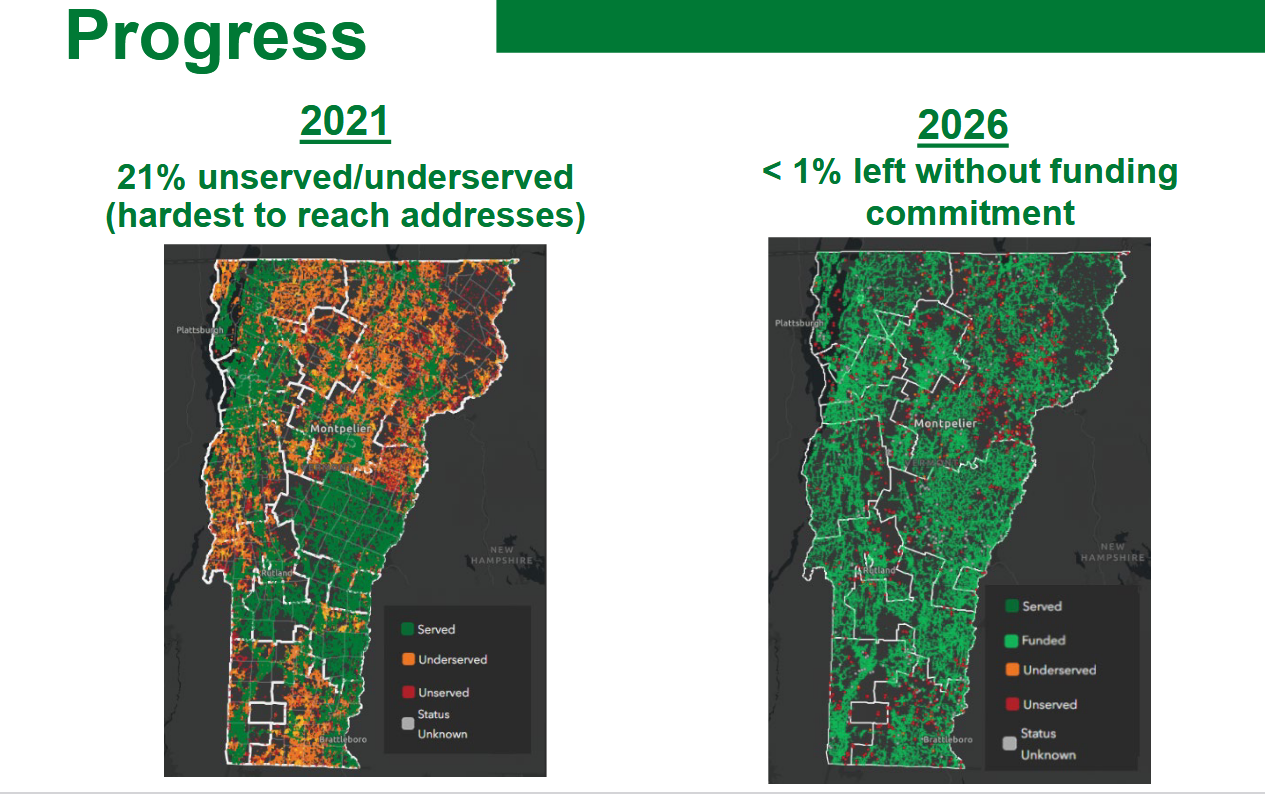
Good news for Vermont. Federal BEAD funding is bringing us closer to universal broadband access, and Vermont is ready for this moment because we did the hard work early. We created Communication Union Districts, built local capacity, and designed a model that works for a rural state with real topographic challenges.
The results are real. We’ve gone from about 30 percent fiber coverage to more than 70 percent in just a few short years. Finishing the job is now in sight.
I’m grateful for the work of the staff and contractors at the Vermont Community Broadband Board and for the leadership behind the BEAD program. Most of all, this progress belongs to the hundreds of communities, utilities, local boards, and workers who kept showing up year after year to make universal broadband a reality.
Data centers
We have begun policy work on how Vermont should approach AI data center proposals. These facilities can place significant demands on electricity, water, and local infrastructure, and testimony this week from the Department of Public Service made clear just how quickly this space is evolving.
Federal policy direction is increasingly aimed at limiting state and local authority to slow or shape these projects. So far, those efforts have not been successful, but they are very much part of the landscape. In response, state regulators and transmission utilities are paying close attention, coordinating closely with one another, and engaging with other New England states to understand risks, grid impacts, and appropriate guardrails.
The goal at this stage is not to encourage or block projects, but to proactively ensure Vermont has clear expectations and review standards in place. That includes understanding impacts on energy costs, grid reliability, water use, and local infrastructure, and making sure decisions are not rushed or made in isolation.
I’m linking background articles below that explain why Vermont is considering this issue now, before any proposals are on the table, and why I support establishing clear standards rather than reacting under pressure later. This week, I also continued early work with researchers focused specifically on data center water use, as part of building a clearer picture of what responsible planning would need to address.
Data center policy background:
- Vermont legislators weigh moratorium vs. permitting framework for AI data centers
(Vermont-focused explainer of the two approaches under consideration) - Vermont Is Making an AI Data Center Decision Every State Will Soon Face
(Regional analysis on energy, affordability, and infrastructure planning)
Judiciary update
Two immigration-related bills, including one on law enforcement identification and masking, were voted out of Senate Judiciary 5–0 this week and are now headed to the House for further consideration.
The first bill, S.208, would require law enforcement officers to clearly display their name, badge number, and agency when interacting with the public. It limits the use of masks or face coverings only when they are used to obscure identity, while explicitly allowing masks for legitimate reasons such as public health, hazardous conditions, or safety. The goal is transparency and accountability, not restricting health protections.
The second bill, S.209, would prohibit civil arrests, including immigration-related arrests, in specified “sensitive locations” such as schools, courts, health care facilities, emergency shelters, and places of worship. Supporters argue this helps ensure people can access essential services and participate in civic life without fear.
Recent State Reports
Annual Telecom Income Report
The state released its annual report on income from electronic communication sites on public land, including mountaintop tower locations. In FY2025, these sites generated about $140,000, with revenue split evenly between Forests, Parks and Recreation and the Department of Public Safety. The report shows a small number of major sites and tenants account for most revenue, and that payments can vary year to year due to late or multi-year payments. As we work on cell tower siting and notice, this provides useful context for how existing infrastructure on public land is managed and funded.
With Valentine’s Day coming up, and with historic challenges in our country, I share this poem as a reminder that love and freedom endure through everyday acts of care and shared responsibility.
I hear America singing, the varied carols I hear,
I Hear America Singing by Walt Whitman
Those of mechanics, each one singing his as it should be blithe and strong,
The carpenter singing his as he measures his plank or beam,
The mason singing his as he makes ready for work, or leaves off work,
The boatman singing what belongs to him in his boat, the deckhand singing on the steamboat deck,
The shoemaker singing as he sits on his bench, the hatter singing as he stands,
The wood-cutter’s song, the ploughboy’s on his way in the morning, or at noon intermission or at sundown,
The delicious singing of the mother, or of the young wife at work, or of the girl sewing or washing,
Each singing what belongs to him or her and to none else,
The day what belongs to the day—at night the party of young fellows, robust, friendly,
Singing with open mouths their strong melodious songs.
As always, please reach out if you need help navigating state services or want to share what you’re seeing locally. I read and value your notes, even if I can’t always respond immediately. I do not have staff and I work year-round, so if you do not hear back in a day or two, please follow up or send a text. If you find my work useful and are able to support it, you can do that here.
Thank you for staying engaged and staying in touch!
Rep. Laura Sibilia
Windham-2 District (Dover, Jamaica, Somerset, Stratton, Wardsboro)
Email: lsibilia@leg.state.vt.us
Phone: (802) 384-0233
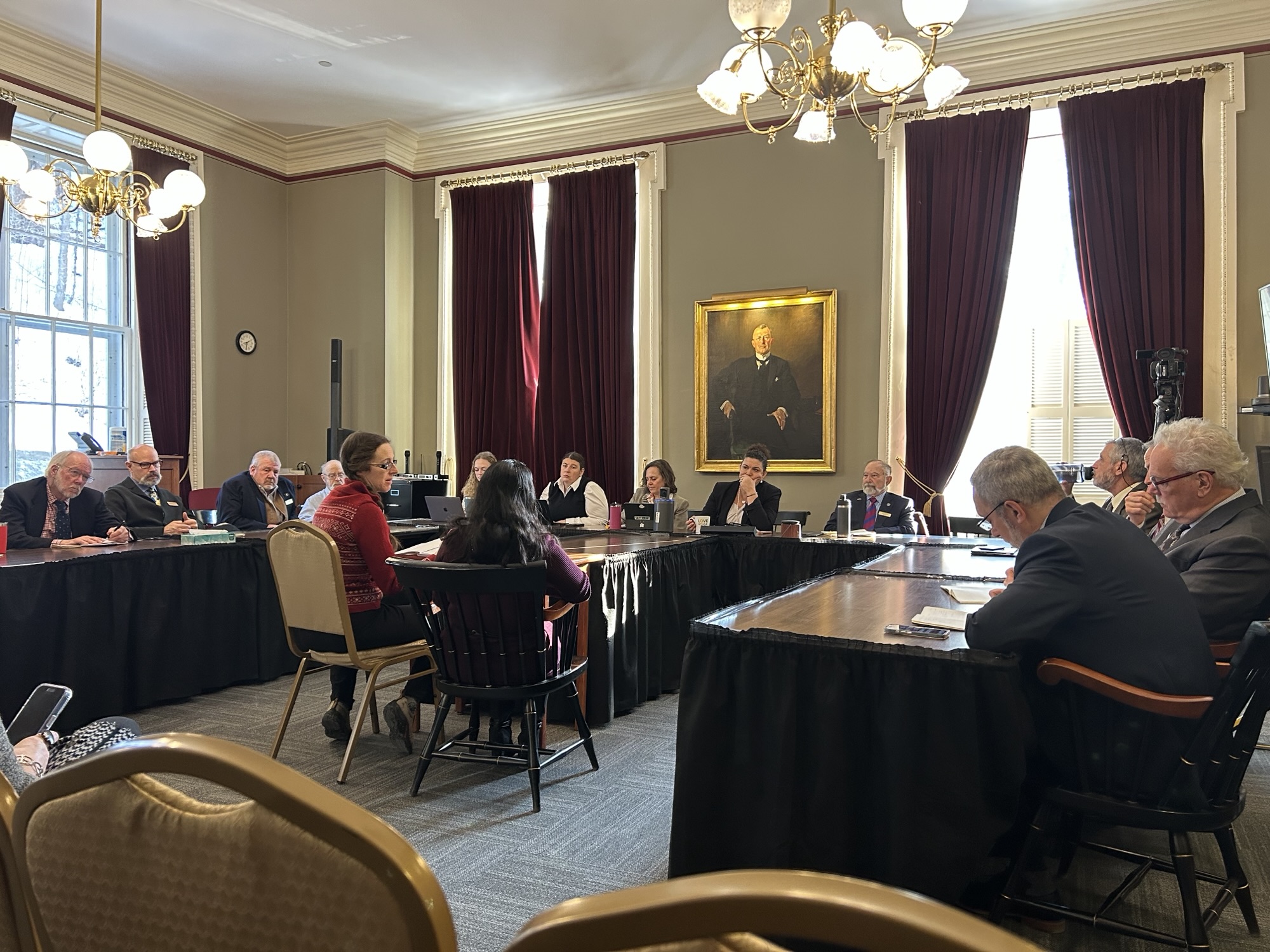
Members of the Rural Caucus talking with Senator Watson and Senator Ram Hinsdale about Act 181
Discover more from Vermont State Representative Laura Sibilia
Subscribe to get the latest posts sent to your email.
 Vermont State Representative Laura Sibilia