This week marked the first full week of the 2026 legislative session. We are right back to work on long-standing challenges here in Vermont, even as national headlines and events abroad have caused real concern and distress for many of you. I have heard from constituents following the shooting of protesters by federal immigration officers and in response to last week’s events in Venezuela.
It is reasonable to be upset by these developments. The rights to free speech and peaceful protest are constitutionally protected and deeply important. Legal information and practical preparation matter, especially in moments like this. Last year I shared guidance on knowing your rights when interacting with law enforcement, and those principles still apply.
At the same time, focusing on local and state government remains one of the most effective ways to strengthen our democracy. Town meetings, school boards, local organizing, and state-level policymaking continue to shape daily life in very real ways. Engagement here is how our communities and state stay grounded and protect our democracy.
As we move through this session, I encourage you to stay in touch. Your questions, concerns, and participation really do matter.
What I heard from you
Thank you to everyone who took the time to fill out my pre-session survey, and for the thoughtful and encouraging feedback many of you shared. What came through most clearly is concern about rising costs. Education costs and property taxes remain the biggest worry, especially when it comes to keeping schools local and accessible while controlling spending. I also heard real concern about housing availability for year-round residents and the strain rising costs are placing on seniors and working families. I appreciate the trust many of you expressed and take that feedback seriously.
State of the State and Education
Governor Phil Scott delivered his 2026 State of the State address on Wednesday, January 7, focusing almost exclusively on education reform and the continued implementation of Act 73. He emphasized alignment with the law’s framework and said he would not sign a budget or education legislation that moves away from that work.
The speech underscored how much pressure Vermont’s education system is under and how much work remains. Over many years the executive and legislative branches have not acted at the scale required to address changing circumstances on the ground affordability, equity, and long-term sustainability. When we fail to provide supports for a system in transition, change happens anyway, just without coherent statewide long-term perspective. I believe we need to continue to move forward and further develop our education reform proposals this year. Read the governor’s full speech here.
Senate President Pro Tempore Phil Baruth has introduced a bill that would place temporary caps on how much individual school districts can increase per-student spending in 2028 and 2029, based on what each district spent the year before. The goal is to slow education cost growth while broader reform work continues, with higher-spending districts allowed less growth and lower-spending districts more room to increase spending.
I have concerns about this approach. It focuses only on local school district budgets, without addressing the cost pressures created by decisions made by the governor and the Legislature. State-level policies related to increased program spending, mandates, healthcare costs, special education, and other requirements all drive spending and property tax rates. Capping local budgets without also restraining those state-level cost drivers, or providing real relief to districts, shifts responsibility entirely onto local communities. Absent those changes, I would not support the proposal.
PUC report on Act 142
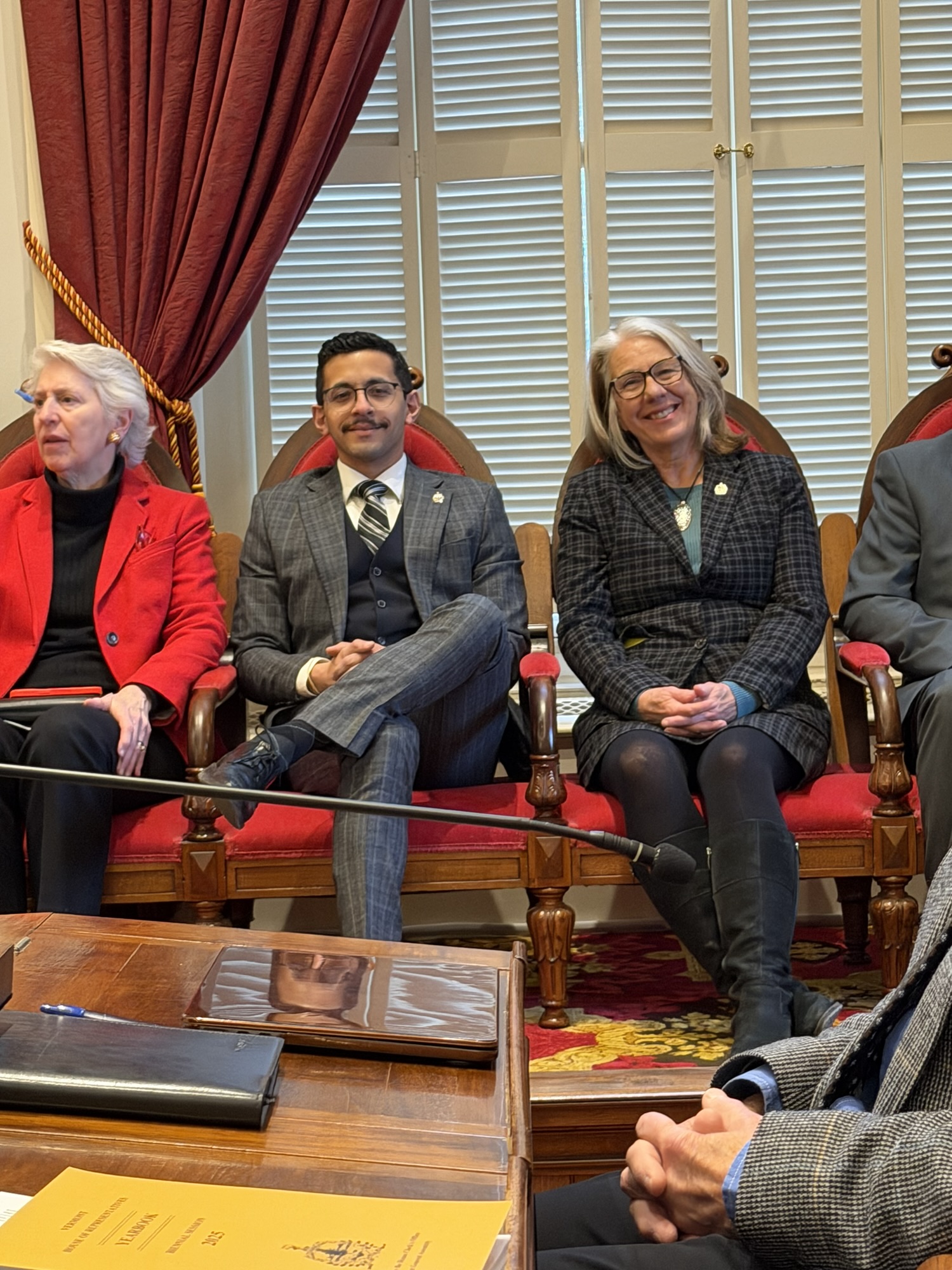
This week, the House Energy and Digital Infrastructure Committee heard testimony on the Act 142 Energy Cost-Stabilization Study, a report the Legislature required to better understand Vermonters’ energy costs and energy burden.
The Public Utility Commission’s findings were clear. Heating and transportation costs are the largest drivers of energy burden for low- and moderate-income Vermonters, not electricity. The Commission concluded that Vermont does not lack programs to address this problem, but it does lack stable, long-term funding to scale what already works.
Rather than recommending a new statewide program, the Commission advised the Legislature to strengthen existing supports. Its recommendations include phasing in an increase to the heating fuel tax to fund low-income weatherization and weatherization readiness repairs, dedicating General Fund dollars to expand LIHEAP and crisis fuel assistance, continuing up-front incentives for high-efficiency vehicles, and expanding Affordable Community Renewable Energy programs to reduce electric bills for income-qualified households. The Commission also emphasized that any increase in heating fuel costs should include a mechanism to make low-income Vermonters whole, such as a tax credit or rebate.
The testimony also highlighted an ongoing structural issue. Delivered heating fuels operate in a largely unregulated market, and growing instability has led to increased consolidation among fuel dealers. That consolidation risks concentrating market power and leaving households, particularly in rural areas, with fewer choices and greater exposure to price swings.
That context matters when comparing policy options. A straight tax on heating fuels is more regressive because it raises costs immediately for households that already spend a larger share of their income on heat and often have the fewest alternatives. A market-based performance standard, such as a Clean Heat Standard or another performance-based mechanism, takes a different approach by placing responsibility on heating fuel distributors to meet clear expectations, including investing in weatherization, efficiency, or cleaner heating options, with the ability to target benefits to low- and moderate-income Vermonters. The reality is that either approach will be extremely difficult to move forward this year. My focus continues to be on a transition that is deliberate, fair, and coordinated, rather than one that continues unevenly and without appropriate statewide oversight.
Vermont’s Climate Action Plan
The Vermont Climate Council will host the second of two events for Vermonters to learn about the Plan’s priority actions and discuss how we are moving from planning into action. We hope you can join the conversation. Register for the virtual event on January 12 at 12:00 pm.
The Vermont Climate Action Plan is a roadmap for how Vermont will continue to act on climate change. Updated in July 2025, it outlines how to cut climate pollution and build resilience in communities and nature.
From the Vermont Health Department
You may have heard that the CDC changed its vaccine recommendations for children. Vermont’s recommendations and school-age vaccine requirements have not changed. Children can still be vaccinated at their doctor’s office or pharmacy as usual.
It is normal to have questions. The Health Department remains committed to providing clear, evidence-based guidance for families and encourages you to talk with your healthcare provider and rely on trusted medical sources, including the American Academy of Pediatrics. More information is available at HealthVermont.gov/VaccineInfo.
Contemplating digital service disruptions
More and more of our daily routines rely on digital services, often without us noticing. Banking, utilities, healthcare, schools, town services, and even gas pumps depend on computer networks working in the background. It is worth pausing once in a while to consider how we manage if one of those services is briefly unavailable.
A few practical steps can help. Use strong passwords and turn on two-step verification when it is offered. Keep a small amount of cash on hand in case card readers or ATMs are temporarily unavailable. Write down important phone numbers or account information somewhere safe. Be cautious with unexpected emails or texts asking you to act quickly or click a link. When something feels urgent, take a moment and go directly to an official website or phone number. Staying connected locally also helps, since town offices, libraries, and local radio often share reliable updates.
Most digital service disruptions are short and manageable. A little preparation can help reduce stress when things are briefly offline.
Federal Pressure
I want to briefly connect what many of you shared in the survey to federal issues I am watching. New analysis from the Committee for a Responsible Federal Budget, a nonpartisan organization that tracks federal spending and long-term debt, shows growing instability in major federal programs, including Social Security. Because Congress has not acted to stabilize the program, benefits are projected to be reduced automatically in about seven years if nothing changes.
When federal systems are under strain, the effects show up locally, in housing costs, healthcare access, property taxes, and community services. At the same time, Vermont is navigating several transitions at once, including climate impacts that are already here, an energy transition that affects daily life, and a wave of retirements, all while state government capacity is already greatly diminished.
In thiscontext, simply talking about affordability is not enough. The real question is whether we are managing change deliberately and honestly, or allowing costs and risk to fall where they may on households and communities.

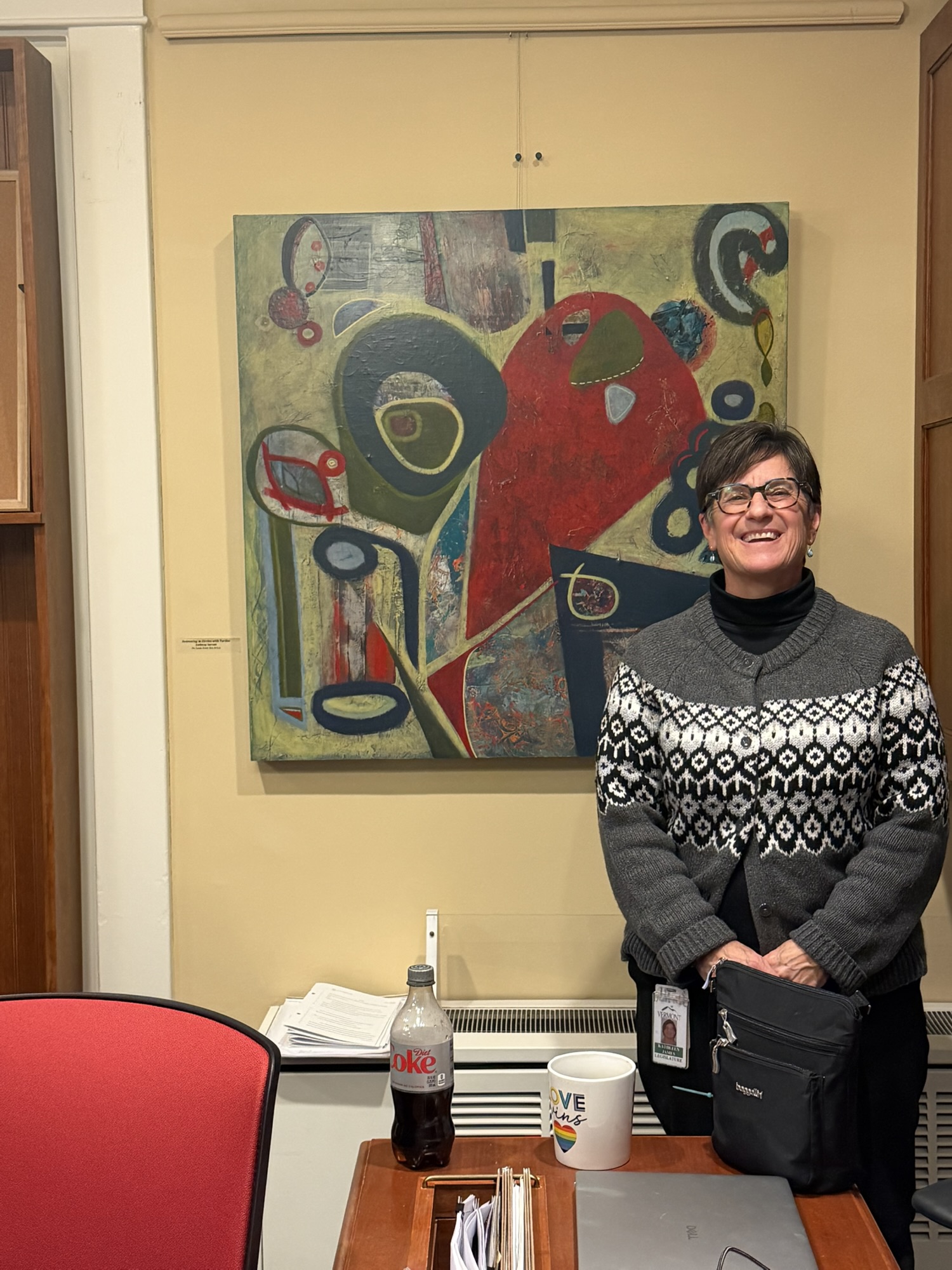
Among the many serious and sometimes overwhelming issues we face, I also try to stay attentive to the things that remind us why this work matters. Just to my right in committee is a vibrant painting by southern Vermont artist Anthony Surratt. The color and light in our committee’s shared space offer a sense of creativity and care, even on long days.
If you need help with state services, please reach out. I do not have staff and I work year-round, so if you do not hear back in a day or two, please follow up or send a text. If you find my work useful and are able to support it, you can do that here.
Thank you for staying engaged and staying in touch!
Rep. Laura Sibilia
Windham-2 District (Dover, Jamaica, Somerset, Stratton, Wardsboro)
Email: lsibilia@leg.state.vt.us
Phone: (802) 384-0233
Discover more from Vermont State Representative Laura Sibilia
Subscribe to get the latest posts sent to your email.
 Vermont State Representative Laura Sibilia