
Friends and neighbors,
The Legislature has officially adjourned for the 2025 session. It was a challenging and consequential year, especially around education. Below, I’ve shared updates on the major bills passed on the final day, including statewide reforms to school funding and governance, updated election procedures, and a new phone-free policy for schools. I’ve also included a timeline of what comes next for H.454, and how Vermonters can weigh in.
I’ll be holding office hours this summer to hear your thoughts and questions. My next sessions are Thursday, June 19 and Thursday, July 17 at 6 p.m. at the Wardsboro Library. I will not be holding office hours in Dover on July 5 or August 2.
As always, thank you for staying informed and engaged.
— Laura
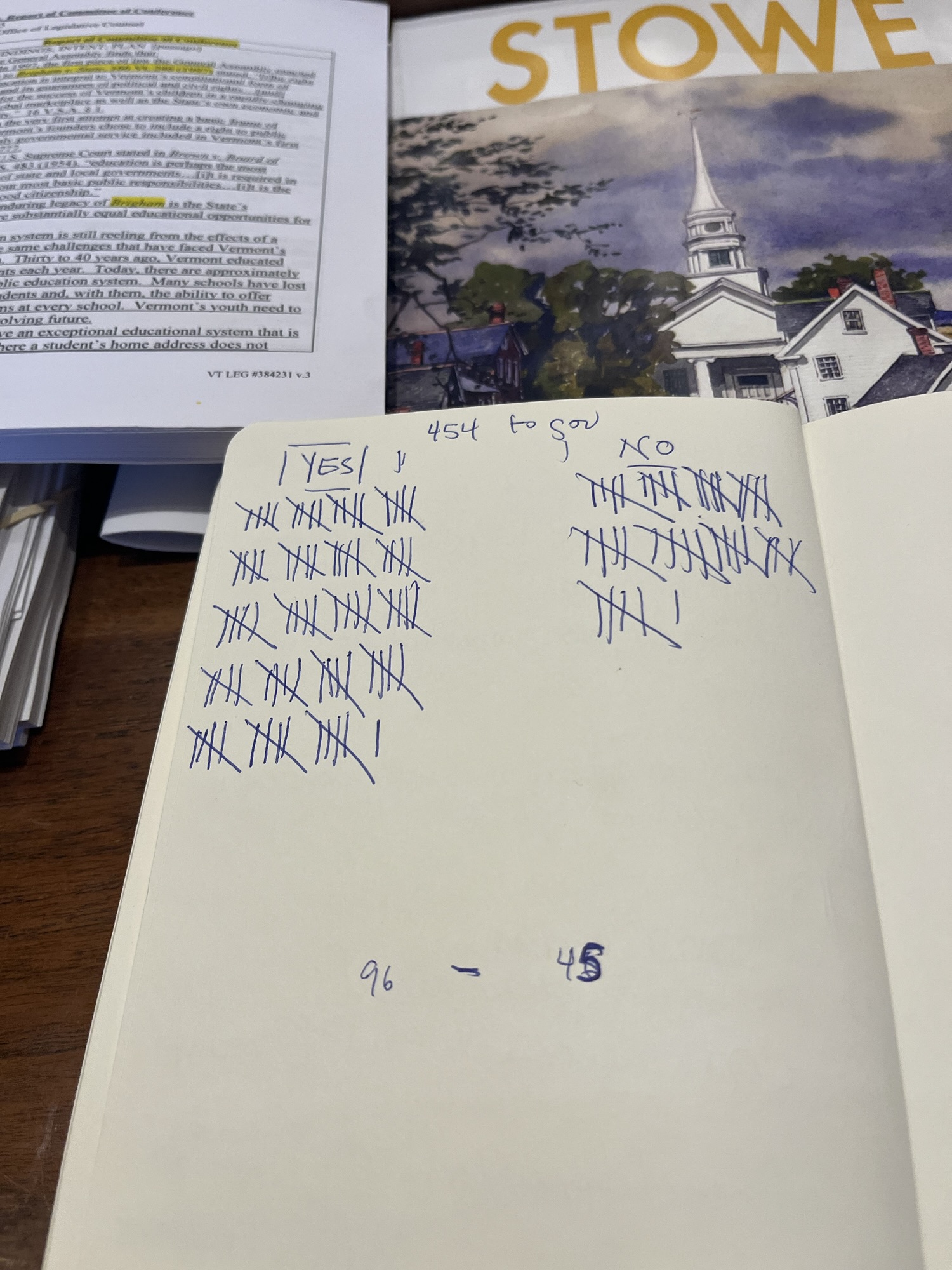
Why I Voted Yes on H.454
Last week, I said the Legislature should not try to do everything all at once, and that layering major funding changes, governance consolidation, and structural shifts into a single, all-or-nothing proposal could backfire. I also said that when deciding how to vote, I would focus on accountability for public dollars, transparent public input moving forward, the likelihood of improving quality statewide, and tax impacts.
On Monday, I voted yes on the final version of H.454. This bill is far from perfect. But it begins the long-overdue work of making the Legislature more accountable for education decisions that affect every community in Vermont, while preserving opportunities for ongoing input and course correction.
The legislation:
- Moves Vermont toward a foundation formula, where the state funds schools through a per-student grant and assumes greater responsibility for equity.
- Begins a multi-year process of school governance reform, requiring the Legislature to approve new district maps next year before major changes take effect.
- Establishes taxpayer protections, a phased implementation, and new oversight structures to review class size, special education, and career and technical education.
- Limits public tuition to private schools to better align with constitutional and equity concerns, especially in districts that have public school options.
This bill does not immediately change how local schools operate. And it does not predetermine outcomes for rural districts. But it does give us a chance to increase state level accountabiity for funding, consistent governance, and a system that better matches Vermont’s current and future needs.
This process is far from over. Over the next two years, the Legislature must consider proposed district boundaries, rework the tax model, and hear directly from Vermonters about how these reforms should take shape. There will be many public hearings. There will be opportunities to shape what comes next. If the Legislature fails to take key actions the process will stall.
As always, I’ll continue working to ensure rural voices are at the table and that public dollars are used transparently and equitably.
Resources
- Final Text of H.454 (as passed)
- Final Fiscal Note – Joint Fiscal Office (June 15, 2025)
- Vermont Public Article: Landmark Education Reform Passes Despite Dissent
- Vermont News & Media: Sweeping Education Reform Passes Legislature
Phone-Free Schools Bill and Elections Refoms Pass
Alongside education finance and governance reform, the Legislature also passed H.480, which will ban the use of personal electronic devices during the school day in all public schools and in private schools that accept public tuition. The ban takes effect in the 2026–27 school year and includes exemptions for students receiving special education or homelessness services. While some Vermont schools have already adopted bell to bell phone bans on their own, this legislation makes the policy statewide.
The Legislature approved a revised version of H.474, a bill that makes several updates to Vermont’s election procedures. The bill includes new requirements for campaign finance disclosures, limits on candidates running under multiple party labels after a primary loss, and a requirement for local officials to audit voter checklists in multi-town districts.
H.454 Education Reform Implementation Timeline
2025: Planning and Rulemaking
- Immediately (on passage, June 2025):
- School District Redistricting Task Force and Voting Ward Working Group are created and begin work.
- Agency of Education (AOE) receives funding to support planning, contracting, and staffing.
- JFO and AOE begin work on studies of the foundation formula and special education.
- By December 1, 2025:
- Task Force submits up to three proposed district maps (approximately 4,000–8,000 students per district).
- AOE submits multiple reports, including:
- Graduation requirements
- Special education cost drivers and strategic plan
- Governance and data infrastructure recommendations
- State Board of Education proposes rules to define “small by necessity” and “sparse by necessity” schools.
2026: Legislative Decisions, Early Implementation
- July 1, 2026 (Contingent):
- If the Legislature adopts one of the district maps, the state begins implementation.
- Class size minimums go into effect (counted as three-year rolling averages).
- New construction aid program launches.
- Property valuation reforms begin.
- AOE begins oversight of tuition eligibility and district consolidation work.
2027: Elections and Infrastructure
- November 2027:
- New district school boards elected, assuming redistricting has been approved.
- Statewide graduation requirements due from the State Board of Education by July 1, 2027.
- Tax departments submit detailed modeling and tax transition plans.
- Preparation begins for property tax classification changes and regional reappraisal system.
2028: Transition to New System Begins
(Only happens if district maps and foundation formula adjustments are approved.)
- July 1, 2028:
- Foundation formula and new funding system begins.
- Statewide education property tax and homestead exemption structure are implemented.
- Tuition eligibility changes take full effect.
- Districts may adopt supplemental district spending via voter approval.
- New property tax classifications implemented: homestead, nonhomestead residential, nonresidential.
- Special education funding shifts to weighted formula.
- Support grants for small and sparse schools begin.
2029–2032: Phased Transition
- Educational Opportunity Payments (the new per-student block grants) phased in over 4 years, gradually replacing existing education spending formulas.
- Supplemental district spending caps decrease from 10% to 5% over this period.
- Regional reappraisal districts go live January 1, 2029.
2033: Full System in Place
- Foundation formula fully implemented.
- Property tax transition complete.
- Structural and funding reforms are fully operational statewide.
Key Contingencies:
- District Redistricting Approval (2026): If the Legislature does not approve new district maps, the core reforms — including the funding formula and tax structure — do not take effect.
- Cost Factor Study (due Dec 2026): Some elements, like adjustments to funding weights (e.g., for high school costs), depend on findings in this report.
During the 2025 legislative session from January through May I will continue to meet on the 1st Saturday of the month at the Dover Free Library from 11-noon and at your group’s invitation as schedules allow. Monitor my votes and the bills I am sponsoring at: https://legislature.vermont.gov/people/single/2026/24023 As always, if you have suggestions, concerns or critiques please be in touch so we can schedule one on one time to discuss. Please do not hesitate to contact me if you need assistance navigating government services at (802) 384-0233 or lsibilia@leg.state.vt.us. Follow my regular posts online at http://www.laurasibiliavt.com

Discover more from Vermont State Representative Laura Sibilia
Subscribe to get the latest posts sent to your email.
 Vermont State Representative Laura Sibilia