
Hello from the State House,
We are in the final stretch of the 2025 legislative session, and big bills are emerging including on clean water infrastructure, health care oversight, education governance, land use, and youth digital safety. Many bills are advancing, some are evolving quickly, and several will require careful negotiation between the House, Senate, and Administration in the days ahead.
Vermont is entering wildfire season, and the Department of Environmental Conservation and Forests, Parks, and Recreation are reminding residents of safety basics. Recalling the air quality impacts we had in Vermont from Canadian wildfire smoke in recent years, when you’re planning a burn, remember to check fire danger levels and air quality, and get a permit from your local forest fire warden. These steps are simple and help protect our neighbors, first responders, and air quality across the state.
Highlights this week include:
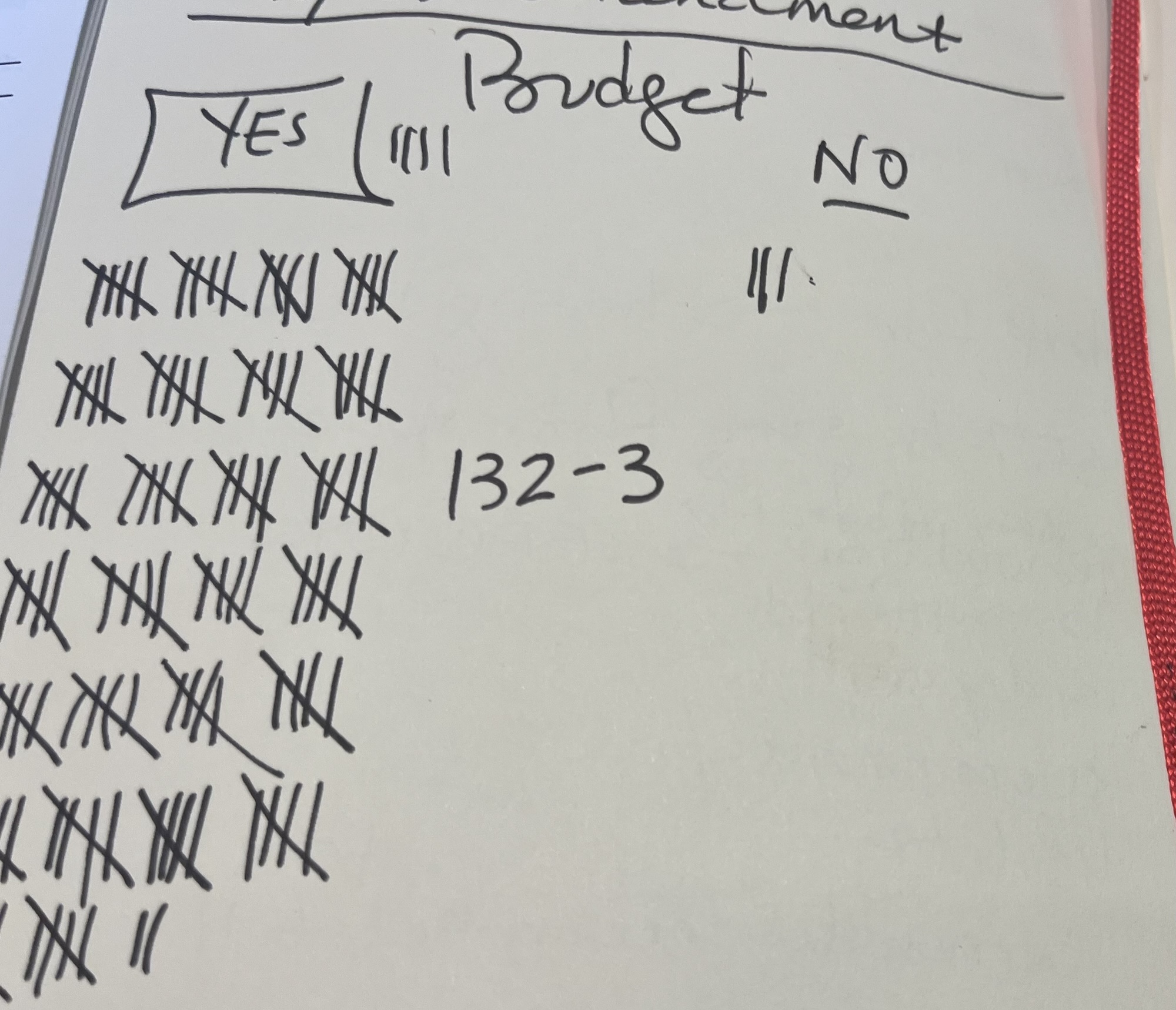
- The Conference Committee’s FY26 budget (H.493) has been approved by the House 132-3
- H.481, updating Vermont’s stormwater permitting structure and funding strategy, has passed both chambers.
- S.63, refining oversight and funding mechanisms for the Green Mountain Care Board, passed the House with broader health reform bills still under discussion.
- Governor’s recent Executive Order on Vermont’s clean vehicle rules.
- In education, concern about the Senate’s significant changes to H.454—particularly the shift away from the public and technical approach taken in the House version.
- Rural Caucus and the Implementation of Act 181 and Tier 3 land use rulemaking continues, with important opportunities for public input in the coming weeks.
There’s more information on each of these topics in the sections below. Thank you for your engagement and questions – please stay in touch.
FY26 Budget Update
The FY26 state budget (H.493), also known as the “Big Bill,” was unanimously approved by the Committee of Conference between the House and Senate and by a vote of 132-3. The Senate passed it Monday morning, and it will be on the House floor Thursday. You can find a breakdown of budget sections—from general government to housing and transportation—here.
One item of note: This year’s budget directs funds from the PILOT Special Fund (which includes contributions from towns with local option taxes) toward two new statewide initiatives – a new ongoing flood buyout reimbursement program, and one time road repairs for towns ineligible for federal disaster aid. These address real needs but differ with what the communities in our district had hoped, which is a return of the PILOT Surplus. This is a topic that we will return to next year.
Links to key documents:
Health Care System Oversight and Reform Updates
This past week the House passed S.63 which proposes several adjustments to the regulatory duties and funding structure of the Green Mountain Care Board (GMCB). The bill modifies the Board’s bill back formula, shifting how costs are allocated among regulated entities, and introduces new fees for accountable care organization (ACO) certification and budget review. It also removes or reassigns certain responsibilities to reflect current priorities in health care reform. These changes refocus GMCB’s work without significantly altering its overall funding. S.63 fiscal note
Two other significant health care bills are moving through the Vermont Legislature right now—H.482, currently in the Senate, and S.126, now in the House. H.482 would expand the Green Mountain Care Board’s emergency powers, allowing it to reduce hospital payments and assign independent monitors if financial or data benchmarks aren’t met which could potentially impact every hospital in Vermont. S.126 proposes major payment reforms, including reference-based pricing tied to Medicare rates by 2027 and a fast-tracked mandate to cut $100M–$200M in hospital spending. I’m watching how these bills evolve and especially their potential impact on rural and critical access hospitals like Grace Cottage.
Shield Bill
Governor Scott has signed Vermont’s updated Shield Bill into law. The law strengthens protections for providers of abortion and gender-affirming care, including those from other shield law states who may travel to Vermont. It also expands access by allowing asynchronous tele-health—online questionnaires—for abortion medication, an important step for rural communities. The bill includes new privacy measures for prescribers and brings all health care advertising under consumer protection law to guard against misinformation.
Education
Update on Senate Version of H.454 – Governance and Timeline differences
This week, the Senate Finance Committee advanced its version of H.454, and there are significant changes from the House-passed bill—especially in finance, governance and implementation timelines. I believe the finance aspects need to be fleshed out after the governance, and are likely to continue to evolve so I will not focus on those here.
Rather than continuing with the House’s approach of tasking a diverse, partially nonvoting Commission on the Future of Public Education with proposing new school district boundaries, the Senate version creates a School District Boundary Task Force composed entirely of legislators. This group would be responsible for putting forward new supervisory union and district maps by December 15, 2025, and would also recommend an alternative process for consolidation if the Legislature doesn’t act by January 31, 2026 – that’s within a few weeks of reconvening next year. The House structure provides more opportunity for public input and technical work through its commission and district boundary subcommittee, while the Senate shifts the responsibility into the legislature. I DO NOT support that shift, because it prioritizes political interests over practical considerations in how districts are drawn.
The Senate also moves up the entire timeline by a full year: new transitional boards would form by January 1, 2027, with fully operational unified districts in place by July 1, 2028 (compared to July 1, 2029 in the House version). House provisions that are not included in the Senate version, include class size minimums for independent schools and required public process around class size waivers.
Based on what I am hearing in the statehouse halls, the Senate’s bill may not have strong support from Senators in either party at this point, possibly due to the scope of the projected district-level cuts for some and the ongoing focus on protecting private schools for others. The accelerated timelines and scale of changes are also raising concerns across Vermont’s districts.
The House and Senate versions are significantly different, both in financing, governance structure and vision for implementation. Deep and difficult negotiation between the House, Senate, and Governor will be required if any version of this bill is to move forward this year.
Fiscal Note Links:
Another bill recently passed out of Senate Education, H.480, that would make several updates to Vermont’s education laws if passed. It requires all schools to establish behavioral threat assessment teams by July 2025 and update emergency response plans to include protocols for cardiac emergencies during athletic activities. The bill limits student use of cell phones and social media during the school day, with specified exceptions. It also maintains virtual learning opportunities aligned with personalized learning plans and requires schools to provide evidence-based reading instruction along with additional support for students who need it.
The bill also updates the process for appointing the Secretary of Education, reinforces existing moratoriums on new approved private independent schools and requires library material selection policies that support intellectual freedom. It prohibits schools from requiring social media use for academic or extracurricular activities.
Take Action: Vermont Kids Code Rally – May 19
Join young Vermonters for a Day of Action to support the Vermont Age-Appropriate Design Code! Rally with us Monday, May 19 at 7:30 AM at the Manchester Center Roundabout to demand accountability from Big Tech and protect youth online. Hear powerful stories, show your support—and enjoy free donuts and coffee! Hosted by Design It For Us.
Optional RSVP: https://actionnetwork.org/events/vermont-aadc-day-of-action
H.481 – An act relating to stormwater management
This bill passed the House and Senate and updates Vermont’s approach to stormwater management. It extends the deadline for property owners to comply with three-acre impervious surface permitting requirements from 2023 to 2028. It allows municipalities that assume full legal responsibility for a stormwater system to assess local fees and access Clean Water Fund support. The bill removes a scheduled reduction and eventual sunset of the Clean Water Surcharge, maintaining the current 0.22% rate to provide consistent funding for water quality initiatives. It directs the Clean Water Board to prioritize $1 million annually—and a one-time $5 million allocation in FY27—for municipal stormwater projects. The bill also establishes a study committee to evaluate the feasibility and benefits of regional stormwater utility districts. While some provisions could shift state revenue and administrative responsibilities, the goal is to strengthen local capacity and ensure sustainable investment in water infrastructure. Fiscal Note (VT Joint Fiscal Office)
Rural Caucus
Ensuring Rural Access to the Community Infrastructure and Housing Program (CHIP)
As Vermont works to address its critical housing and infrastructure needs, the Legislature is advancing a new financing tool through S.127, the Community Infrastructure and Housing Program (CHIP). While the program has the potential to be transformative, members of the Rural Caucus have raised important concerns about the complexity of the proposal and the risk that rural communities may be left behind.
To ensure CHIP works for towns of all sizes, the Rural Caucus has been actively engaging with local and statewide partners—including regional development organizations, VLCT, and chambers of commerce—to reduce complexity and increase equitable access. Our goal is to ensure that rural municipalities with fewer resources can still participate meaningfully in this opportunity.
There is growing consensus around several areas for improvement, including:
- Avoiding location-based eligibility requirements that may unintentionally exclude small towns;
- Ensuring flexibility in housing-to-commercial ratios so rural zoning isn’t a barrier to mixed-use projects;
- Using a broad, inclusive definition of public infrastructure;
- And taking a closer look at the proposed cap on Education Fund exposure to avoid disadvantaging less-resourced or less shovel-ready communities.
Negotiations are ongoing, and the voices of rural Vermonters are being acknowledged by House Leadership. The Rural Caucus will continue working to ensure CHIP reflects the needs and realities of all communities in this year’s housing bill.
Act 181 and Tier 3 – What’s at Stake for Rural Vermont
The Rural Caucus is closely monitoring the implementation of Act 181, Vermont’s new land use law passed last year. This legislation is creating a tiered system for Act 250 jurisdiction that will impact every region of the state differently.
Tier 1 areas which will include much of our our largest towns and our designated centers will see greatly reduced Act 250 requirements. Tier 3 areas, which are intended to protect critical natural resources, will likely include many parts of rural Vermont. These rules will influence land use, development potential, and conservation efforts for years to come.
The Land Use Review Board is beginning the Tier 3 rulemaking process and is currently seeking public input. A public engagement session will be held:
May 22, 6–8 p.m.
In person: Essex Junction
Online: Microsoft Teams
Details and agenda are available here: Tier 3 Rulemaking and Report
Comments and questions can also be submitted anytime by email: act250.rulemaking@vermont.gov
The Rural Caucus has been talking with both the Land Use Review Board and Regional Planning Commissions, and we’ve asked how they’re engaging the public, especially in rural areas, as these maps and rules are developed.
These are decisions that will shape the future use and value of ALL parcels in EVERY community. We encourage Vermonters to stay informed and participate in the process.
More background on Act 181 is available here: Overview and Projects
Update on Vermont’s Clean Cars Rule and Governor’s Executive Order
In 2022, Vermont adopted the Advanced Clean Cars II, Advanced Clean Trucks, and Heavy-Duty Omnibus rules — joining other states in requiring auto manufacturers to steadily increase the number of zero-emission vehicles (ZEVs) they offer, starting with model year 2026. These rules were intended to reduce greenhouse gas emissions, improve air quality, and expand access to cleaner vehicle options for Vermonters.
On May 13, Governor Scott issued an Executive Order directing the Agency of Natural Resources to pause enforcement of these rules for 18 months. The order cites a lack of charging infrastructure, challenges with heavy-duty vehicle technology, and supply chain disruptions. It allows manufacturers more flexibility — as long as they aren’t shifting sales burdens onto Vermont dealerships. Read the full order and original rule.
Protecting yourself when protesting, Know Your Rights: What to Do if You or a Loved One is Detained

Federal Funds under the Trump Administration
This is a live webpage from the Joint Fiscal Office dedicated to tracking the impact of federal policy on states. The current presidential administration has issued executive orders freezing federal funds, discussed the elimination of federal programs, and has proposed significant changes to tax policy. Congressional budgetary actions could further impact states.
Recent Reports to the Legislature
Vermont Bond Bank – 2024 Annual Report In 2024, the Vermont Bond Bank provided $199.6 million in loans to 52 borrowers, marking its highest level of annual activity to date. The year included the launch of three new programs focused on flood recovery, small water systems, and energy efficiency. The Bond Bank now manages a total loan portfolio of $885.6 million, including $591 million through its Pooled Loan Program. Investments made through these programs supported a range of community infrastructure projects—such as facility upgrades, park improvements, and street and bridge work—affecting an estimated 200,000 Vermonters. The Bond Bank also continued to help municipalities access capital with consistent processes, competitive rates, and cost-saving opportunities through bond refinancing.
Bills That Have Passed Into Law and Signed by Governor
- H.13, An act relating to Medicaid payment rates for community-based service providers
- H.96, An act relating to increasing the monetary thresholds for certificates of need
- H.206, An act relating to the Uniform Commercial Code
- H.218, An act relating to fiscal year 2026 appropriations from the Opioid Abatement Special Fund
- H.463, An act relating to technical corrections for the 2025 legislative session
- S.18, An act relating to licensure of freestanding birth centers
- S.28, An act relating to access to certain legally protected health care services
- H.21 An act relating to service of writs of possession
- H.243 An act relating to the regulation of business organizations
- H.118 An act relating to expanding the scope of hate-motivated crimes
- S.30 An act relating to updating & reorganizing the health insurance statutes in 8 V.S.A. chapter 107
- S.9 An act relating to after-hours access to orders against sexual assault
- H.259 An act relating to preventing workplace violence in hospitals
- S.3 An act relating to the transfer of property to a trust
- H.80 An act relating to the Office of the Health Care Advocate
- H.154 An act relating to designating November as the Vermont Month of the Veteran
- H.2 An act relating to increasing the minimum age for delinquency proceedings
- H.31 An act relating to claim edit standards and prior authorization requirements
- H.35 An act relating to unmerging the individual and small group health insurance markets
- H.78 An act relating to the use of the Australian ballot system in local elections
During the 2025 legislative session from January through May I will continue to meet on the 1st Saturday of the month at the Dover Free Library from 11-noon and at your group’s invitation as schedules allow.
Monitor my votes and the bills I am sponsoring at: https://legislature.vermont.gov/people/single/2026/24023
As always, if you have suggestions, concerns or critiques please be in touch so we can schedule one on one time to discuss. Please do not hesitate to contact me if you need assistance navigating government services at (802) 384-0233 or lsibilia@leg.state.vt.us. Follow my regular posts online at http://www.laurasibiliavt.com

Discover more from Vermont State Representative Laura Sibilia
Subscribe to get the latest posts sent to your email.
 Vermont State Representative Laura Sibilia