


Dear Friends and Neighbors,
This week, we passed a significant piece of legislation, H.454, aimed at overhauling our education system to better serve Vermont’s students and communities. It’s a bill that reflects bold thinking and, like all major reforms, it’s going to take continued collaboration to get it right. But that’s what we do in Vermont and I have confidence we can find common ground through this process.
In this update, you’ll also find information on public health efforts to combat the rise in measles, new opportunities for Vermonters with disabilities to build financial security through ABLE accounts and my latest blog post on state’s right to act on climate change and the energy transition.
As always, I’m here to listen and engage, so if you have thoughts or concerns, don’t hesitate to reach out. Let’s dive into the details.
Scheduling Community Conversation & Support Events
These conversations are rooted in the spirit of mutual aid which is showing up for each other with time, skills, food, or simply by listening. Everyone is welcome.
The first event is scheduled for:
Jamaica Town Hall – April 26th at 2 PM
Additional dates for Dover, Wardsboro and Stratton will be announced soon. If you’d like to get involved in planning, just reach out.
H.454 – A Bill to Transform Vermont’s Education System
Today the House passed this bill on a vote of 88-54. I voted in support of this bill because it is comprehensive in nature, because it moves forward at an aggressive but accessible pace, and because it is set up in a way that anticipates and expects it will need to be adjusted. The bill now heads to the Senate. The Governor has expressed gratitude for the work so far, but has signaled that he can not agree with the bill in its current form. That means more changes are likely. The consistent thing with big education bills in the legislature is that they are emotional and always have aspects that everyone doesn’t like – though its not always the same thing. In order to get anything done, legislative leaders and the governor have to work in a careful way top maintain enough support to enact changes.
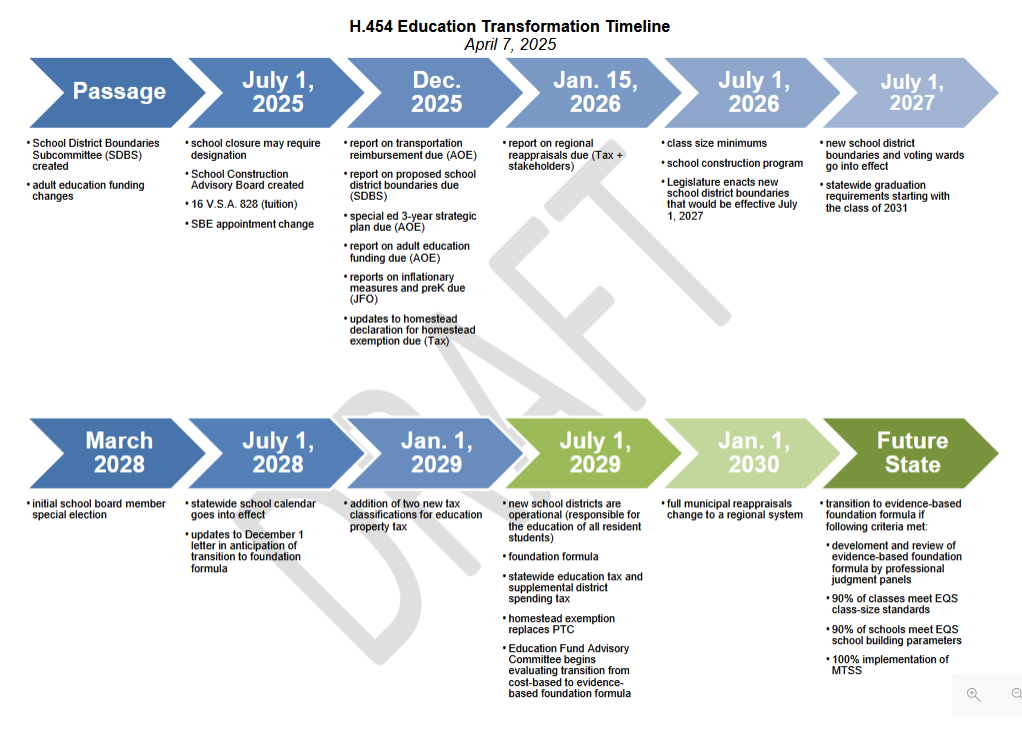
This bill, originally introduced by the Governor’s administration, is now the House Education Committee’s main plan for updating how public education works in Vermont. It focuses on school district boundaries, local school boards, class sizes, and how the state supports and oversees education. Here’s what it would do:
Key Dates and Changes Ahead
- 2026: New, larger school district boundaries will be drawn.
- 2027: New voting wards within districts will be created for electing school board members.
- 2028: First elections for school boards in the new districts.
Focus Areas of the Bill
1. Commission on the Future of Public Education
This commission will continue its work with a sharper focus. A new subcommittee will propose three possible maps for school district boundaries by December 2025. Their work will include public input and expert advice to make sure district lines make sense for Vermont’s geography, culture, and school capacity.
2. Schools and Classrooms
- Sets minimum class sizes:
- Kindergarten: 12 students
- Grades 1–4: 15 students
- Grades 5–12: 18 students
- (Excludes special education, English learners, AP, and tech programs)
- Schools that fall short for two years in a row may face review by the State Board of Education.
- Middle and high schools should aim for at least 450 students total on average.
- Includes new support and aid for updating and modernizing school buildings.
3. Statewide Approach
- Introduces a statewide school calendar starting in the 2028–2029 school year.
- Creates a new School Construction Division in the Agency of Education to manage aid and oversee a statewide school finance system by 2029.
4. State Oversight
- The State Board of Education would get more authority, with new members appointed by the House Speaker and Senate leadership.
- The board would review and update education rules to keep them relevant.
5. Changes to Tuition will only be paid to:
- A public school located in Vermont or another state.
- An approved independent school located in Vermont that meets the following criteria:
- Approved under current law by July 1, 2025.
- At least 51% of the total student enrollment is attending on public tuition.
- Complies with the minimum average class size requirements.
- May request a waiver from the State Board of Education (SBE) if unable to meet class size minimums due to geographic isolation.
- A therapeutic approved independent school.
A transition provision allows students currently enrolled in approved independent schools that do not meet these criteria to continue receiving tuition payments to their current school until graduation.
- For full details—including cost estimates, fiscal notes, and comparisons—visit the Joint Fiscal Office’s page on the bill:
Measles Is on the Rise—Here’s What You Should Know
Measles is one of the most contagious infectious diseases and can be especially dangerous for young children. While it’s now rare in the U.S. thanks to vaccines, outbreaks can still happen—especially in communities with low vaccination rates. Measles remains common in many parts of the world, and unvaccinated travelers can bring it back.
In Vermont, 93% of school-aged children are vaccinated—below the 95% needed for strong community protection. Find your school or county vaccine data here.
Our relatively high rates are due to Vermont’s robust vaccine programs, which make vaccines free and accessible to all children and most adults.
If measles is detected in Vermont, the Health Department:
- Notifies and checks the protection status of those exposed
- Offers free vaccines
- Coordinates antibody treatments for those at higher risk
- Monitors exposed individuals for symptoms
- Supports people in isolation with essentials
- Keeps health care providers and the public informed, while protecting privacy
Learn more about measles here.
ABLE Accounts: Building Financial Security for Vermonters with Disabilities
The Vermont State Treasurer’s Office proudly promotes ABLE (Achieving a Better Life Experience) accounts—tax-advantaged savings tools that help individuals with disabilities save for the future without losing access to Medicaid, SSI, or other benefits. Funds can be used for education, housing, healthcare, and more.
Over 1,000 Vermonters are using ABLE accounts today, but many more are eligible. To encourage new sign-ups, Vermonters who open an account in April will receive a $25 incentive.
And beginning in 2026, ABLE eligibility will expand to those with a disability onset before age 46—broadening access to more Vermonters, including veterans.
Learn more and help spread the word: ABLE accounts give Vermonters the tools to plan ahead, live with dignity, and build a more inclusive community.
Learn more about ABLE here
The Guardian: US banks predict climate goals will fail – but air conditioning firms will thrive


Weekend Adjournment Rep. Jonathan Cooper represents Stamford, Searsburg and Readsboro, towns I used to represent prior to the 2021 reapportionment. We sit close to each other in the Chamber and huddle up from time to time on issues related to those towns or our work together in Southern Vermont.
Recent Reports to the Legislature
Annual Progress on Eliminating Tobacco Use and Vaping in Vermont This brief provides an overview of Vermont’s efforts and opportunities in eliminating nicotine and tobacco addiction, highlighting progress and challenges over the past 50 years. Despite recent increases in the availability of flavored tobacco products, the state’s tobacco control work is built on decades of evidence from research and practice. The brief discusses the disproportionate marketing of tobacco products to certain communities, the limitations of Vermont’s tobacco excise tax in regulating product density and promotion, and the need for stronger consumer protections. It also emphasizes the importance of expanding access to evidence-based treatments for nicotine dependence to support healthier communities and reduce tobacco-related harm.
Bills That Have Passed Into Law and Signed by Governor
- H.2 An act relating to increasing the minimum age for delinquency proceedings
- H.31 An act relating to claim edit standards and prior authorization requirements
- H.35 An act relating to unmerging the individual and small group health insurance markets
- H.78 An act relating to the use of the Australian ballot system in local elections
During the 2025 legislative session from January through May I will continue to meet on the 1st Saturday of the month at the Dover Free Library from 11-noon and at your group’s invitation as schedules allow.
Monitor my votes and the bills I am sponsoring at: https://legislature.vermont.gov/people/single/2026/24023
As always, if you have suggestions, concerns or critiques please be in touch so we can schedule one on one time to discuss. Please do not hesitate to contact me if you need assistance navigating government services at (802) 384-0233 or lsibilia@leg.state.vt.us. Follow my regular posts online at http://www.laurasibiliavt.com

Discover more from Vermont State Representative Laura Sibilia
Subscribe to get the latest posts sent to your email.
 Vermont State Representative Laura Sibilia