
Dear Friends and Neighbors,
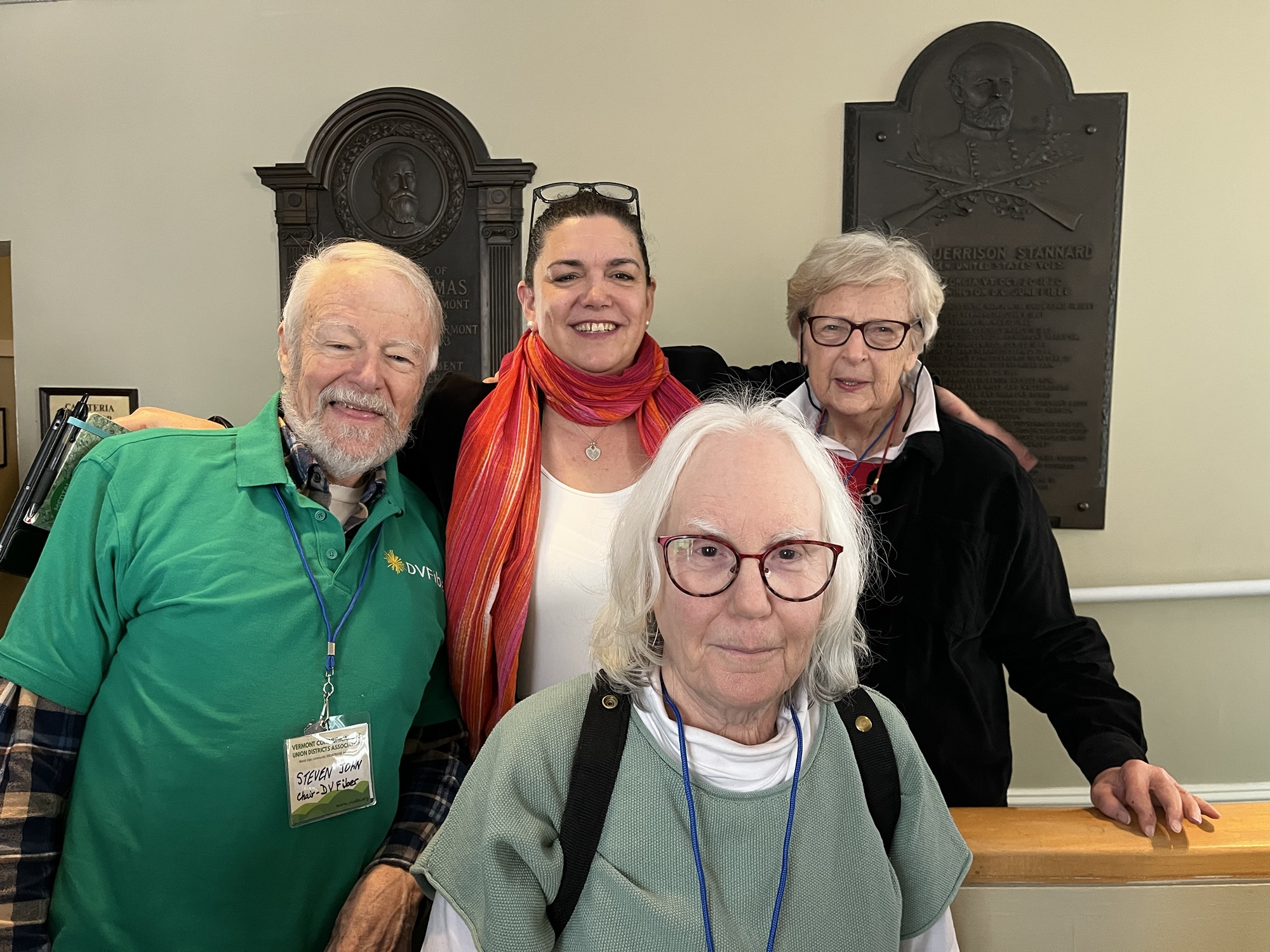
As we move further into the legislative session, I want to take a moment to reflect on a lot of important conversations happening across Vermont. This past week, we saw Vermonters exercising their right to protest, a key part of our democracy. We also hosted our Communications Union Districts (CUDs) in the State House, reinforcing the importance of broadband access for rural communities. In committee, I introduced two consumer protection bills aimed at strengthening fairness and transparency in telecom and energy.
Governor Scott’s education proposal is generating significant discussion. I am concerned about its potential impact on rural communities. The need to strengthen public institutions, rather than rely on competition to deliver services to those communities, is critical to maintaining access in every corner of Vermont. I will continue to advocate for policies that keep our rural communities strong, locally connected and with equitable access to publicly paid for services. Next week, on Wednesday February 19th from 5:30-7:00 pm, the Rural Caucus will be hosting an in person and virtual public forum – details on how to participate will be included in my next update.
At the national level federal policies on artificial intelligence, tariffs, and education will have real impacts in our state and I have included some detail below.
Thank you for staying engaged!
Governor Scott’s Education Plan:
The next aspect of Governor Scott’s education governance proposal was released this week and is generating significant conversation, particularly concerning its expansion of school choice. I am very worried about its potential impact on rural communities. The plan’s focus on school choice, centralized administrative support, and the restructuring of districts is intended to reshape Vermont’s education system. However, it also raises questions about equity, competition, and the future of Vermont’s public schools. The latest proposal is here. Here are the main details:
- Assignment of every student to a public school: Currently students that live in districts without a school can choose any public or papproved private school. In this proposal every student will be assigned to a public school.
- Expansion of School Choice: Under the proposal, all students would be eligible for school choice, regardless of where they live. Students could attend public or approved independent schools, with eligibility determined by a lottery system.
- School District Restructuring: The state’s 119 school districts would be consolidated into five regional districts, each serving between 10,000 and 34,000 students. Each district would be governed by a five-member school board, with the largest district having seven members. Advisory committees consisting of students, parents, educators, and community members would be formed in each district.
- School-Choice Schools: Each district would designate at least one “school-choice school,” which could be either public or private. These schools would need to meet state-established criteria for education quality and financial sustainability. There would be no limit on how many school-choice schools a district could approve.
- Tuition for Private Schools: Private schools designated as school-choice schools would receive the same per-student tuition as public schools.
- Centralized Administrative Support: Each district would have a central office to provide services like curriculum development and professional development. The size of the central office would be proportional to the student population, with larger districts receiving more resources.
- Funding Model: A new foundation formula would determine the funding each district receives, with larger districts being resourced for larger central office teams based on student numbers.
Governor Scott’s plan raises significant questions for me. Universal choice, charter school and voucher systems rely on competitive markets for access, quality and cost containment. This has the potential to create the same harm to rural Vermont as national economic policies like deregulation of telecom which also relies on competition to deliver service and has deeply disadvantaged rural America. In reality, rural communities often require government regulation and subsidies to ensure accesss to public goods like transportation, education and healthcare. Strengthening public institutions, including schools, rather than increasing competition, is needed in order to ensure the livibility of rural areas. The expansion of school choice could exacerbate existing inequities related to limited educational options and transportation challenges. The plan’s market-driven competitive approach combined with a lottery-based admission system for private schools create a lot of questions for me about student and taxpayer fairness.
There are many stakeholders involved in discussions on the needed reform to our education delivery system, as there should be. However, it is becoming increasingly common to hear some businesses and political entities claim that stakeholders they disagree with are biased. It’s important to recognize that everyone brings their own perspectives to the table, and that there are a lot of paid entities at the table. Here are some of the key groups driving the conversation on reform in the statehouse:
- Private organizations: Both for-profit and non-profit businesses, such as Burr and Burton Academy, St. Johnsbury Academy, Campaign for Vermont, Institute for Justice, the Ethan Allen Institute, Vermont Independent School Association, Public Assets Institute and the ACLU which are accountable to their boards and donors.
- Political organizations: Groups like Americans for Prosperity and the anti-LGBT hate group Alliance Defending Freedom, which rely on donations from individuals and entities whose names remain anonymous for donations under $100,000. These organizations are accountable to their boards and donors.
- Political parties: Democrats, Republicans and Progressives who are accountable to their donors and members.
- Teachers’ unions: Organizations like the NEA, which are accountable to their members, primarily teachers, who are the closest to the students in the education system.
- School administrators: Superintendents, principals, and business managers, who are accountable to the public and to elected school boards, and who must uphold local, state, and federal law.
- School boards: Publicly elected officials who are accountable to the voters who elect them.
- Parents and citizens: Key participants in the dialogue about public education and taxation.
The plan’s restructuring of the state’s school governance system and funding model continues to be reviewed and debated by legislators, with a mix of support and concern from the various stakeholders listed above.
I’ll continue to keep you updated as this conversation evolves. We are almost 1/3 of the way through the legislative session.

On Friday, I attended a meeting in Tampa as a member of the 2025 NCSL Task Force on Artificial Intelligence, Cybersecurity, and Privacy, organized by the National Conference of State Legislatures (NCSL), a bipartisan organization that supports state lawmakers. During the meeting, we discussed the intersection of AI, digital privacy, and cybersecurity. Topics included the Institute of Applied Engineering’s contributions to national security, Florida’s efforts through Cyber Florida to lead in cybersecurity, and the growing need for stronger digital privacy protections. We also participated in a roundtable with cybersecurity experts, examined AI’s potential and risks, and reviewed state and federal legislative initiatives on these issues. The task force’s focus was on developing policies that balance innovation, privacy, and security, while emphasizing the protection of residents and strengthening state-level cybersecurity. Here is a report done over the past year to understand how AI is being utilized in federal and state government.
Managing Federal Action
Governor Scott has asked his administration to take a measured, fact-based approach to major federal policies coming out of Washington, D.C. Stay focused on Vermont, avoid knee-jerk reactions, and make sure any response is grounded in real data, not just rhetoric.
One big issue on the table is President Trump’s proposed tariffs. While they’re on hold for now, the Governor has put Secretary of Commerce Lindsay Kurrle in charge of a team that will assess how they might impact Vermont -both the risks and any potential benefits. The team includes the Agency of Commerce, Department of Labor, Agency of Agriculture, and the Public Service Department.
The Governor has made it clear he’s not a fan of tariffs, especially when they could drive up costs for working Vermonters. But he has said he also wants to fully understand what the administration is trying to achieve before taking a firm position. If you want to read the full press release, you can check it out here.
Public Hearings on FY26 Budget
The House and Senate Committees on Appropriations will hold two joint public hearings on the FY26 budget:
- Thursday, February 13, 2025, at 1:45 p.m.
- Thursday, February 20, 2025, at 5:00 p.m.
This is an important opportunity for Vermonters to share their priorities directly with legislators. If you’d like to testify, you must sign up in advance here: Sign Up Form
Once signed up, you’ll receive instructions on how to participate. You can also watch the hearings live on YouTube: Legislative Streaming
NPR: Trump’s executive actions are getting challenged as ‘arbitrary.’ What does that mean?
Latest Legislative Reports
- Women’s Correctional and Reentry Facility Site Proposal Department of Buildings and General Services – The Department of Buildings and General Services (BGS) reviewed 165 sites for the new Women’s Correctional and Reentry Facility, narrowing it down to two state-owned sites in Essex. BGS and the Department of Corrections are now seeking local approval, with a decision on a change of use request pending.
- 2024 Vermont Law Enforcement Agency Drone Use Department of Public Safety – in 2024, the Vermont State Police used drones to support investigations 131 times
- Annual Report on Early College Programs in the Vermont State Colleges System Vermont College System – Act 77 of 2013 created the Flexible Pathways Initiative to expand high school completion options, including the Early College program, which allows students to complete 12th grade at a postsecondary institution. 377 students were enrolled this fall and showed high continuation rates, but questions remain about whether the program is effectively reaching and supporting all students, particularly those who may not see college as a viable path.
Bills I’ve sponsored
- H.144 An act relating to enhancing food allergen awareness in food service establishments The bill would require food service establishments to designate food safety officers trained in allergen awareness and post signage about food allergens. It also mandates that menus include a request for customers to inform staff of any food allergies. The bill would take effect on July 1, 2025.
- H.164 An act relating to the distribution of local option tax revenue and the PILOT Special Fund The bill proposes increasing the share of local option tax revenue distributed to municipalities from 70% to 80% and allocating any surplus in the PILOT Special Fund back to the municipalities that contributed to it. It also directs JFO to study a system where the state retains only the necessary funds for PILOT administration without generating surpluses.
- H.169 An act relating to amending the prohibitions against discrimination in public accommodations and housing This bill would prohibit landlords from requesting Social Security numbers on rental applications and require them to accept all forms of government-issued identification. It also expands anti-discrimination protections in public accommodations and housing by adding citizenship and immigration status to existing protected categories.
During the 2025 legislative session from January through May I will continue to meet on the 1st Saturday of the month at the Dover Free Library from 11-noon and at your group’s invitation as schedules allow.
Monitor my votes and the bills I am sponsoring at: https://legislature.vermont.gov/people/single/2026/24023
As always, if you have suggestions, concerns or critiques please be in touch so we can schedule one on one time to discuss. Please do not hesitate to contact me if you need assistance navigating government services at (802) 384-0233 or lsibilia@leg.state.vt.us. Follow my regular posts online at http://www.laurasibiliavt.com

Rep. Laura Sibilia – Dover, Jamaica, Somerset, Stratton, Wardsboro
Discover more from Vermont State Representative Laura Sibilia
Subscribe to get the latest posts sent to your email.
 Vermont State Representative Laura Sibilia