Wishing all those celebrating a joyous and meaningful Passover! May this festival of freedom and renewal bring blessings of peace, happiness, and prosperity to you and your loved ones.
Education is the key to unlock the golden door of freedom. – George Washington Carver

This week is a consequential one for Vermont’s Education System with major votes in the Legislature. The Senate Education Committee will hold its Confirmation Hearing for Zoie Saunders, Governor Scott’s pick for Education Secretary on Tuesday at 2 pm. Watch the hearing here. At a later date the Education Committee will make a recommendation to the full Senate on whether or not to approve the pick. Questions and statements about her qualifications and lack of public education experience have entered the public debate and confirmation by the entire Senate is not a certainty.
Read the Governor’s press release on selecting Zoie Saunders as Vermont Education Secretary.
In the House the Yield Bill will be up for debate, also on Tuesday. H.887 is An act relating to homestead property tax yields, non homestead rates, and policy changes to education finance and taxation.
The Yield Bill adjusts property and income tax rates for homesteads and non-homestead. It plans to increase the Education Fund’s revenue by removing the sales tax exemption for remotely accessed prewritten software and adding a 1.5% surcharge on short-term rentals. The revenue from these changes will be dedicated to the Education Fund.
The bill also establishes several groups and commissions, including the “Commission on the Future of Public Education in Vermont,” the “Educational Opportunity Payment Task Force,” and the “Education Fund Advisory Committee.”
The Joint Fiscal Office (JFO) estimates that these changes will lead to an average increase of about 14.97% for home property tax bills and income education tax bills, and an average increase of 17.99% for non-home property tax bills. The removal of the sales tax exemption for prewritten software is expected to generate an additional $20.4 million for the Education Fund in fiscal year 2025, and the 1.5% surcharge on short-term rentals is expected to generate $6.5 million for the Education Fund in the same year.
The bill also includes provisions for adjusting calculations related to local common levels of appraisal (CLA), establishing an excess spending threshold for per pupil education spending in fiscal years 2026 and 2027, and expanding the use of a fiscal year 2024 General Fund appropriation. It also includes intent language for the appropriation of $125,000 from the General Fund to the Agency of Education (AOE) in fiscal year 2025.
For more details, you can refer to the full text of the bill here. And here is the Yield Fiscal Note
There are a host of amendments being offered to the bill that will likely all fail to pass including my amendment to require State-directed spending be defined and included in the Dec. 1 letter from the Tax Commissioner to School Districts. (see my latest oped on this issue)
- An additional study analyzing the fiscal and administrative impacts of shifting the responsibility for retirement costs and administrative expenses of active teachers from the Education Fund to the employing independent school or school district.
- Removing the Short Term Rental Charge and the Repeal of the Cloud Tax
- Reinstating the Excess Spending Threshold and Penalty for FY 2025 Budgets (many of these budgets have already been approved by voters)
I’ve signed on to these two amendments:
- Requiring any districts that stop operating a school to designate up to three public schools or the four traditional academies (Burr & Burton, St. Johnsbury, Thetford, Lyndon) for their students.
- Restore authority over the Agency of Education to the State Board of Education
Separate from the Yield Bill, I have proposed an Amendment to the Rules of the House which would require all spending from the Education Fund that the Legislature and Governor direct be voted on in stand alone bills and be passed by 2/3 of the House rather then a simple majority.
Want to understand a bit more about the funds that go into the Education Fund? Here is a highlight document from the Vermont Department of Taxes from 2020.
2024 River Valleys Unified School District Annual Meeting: Scheduled for April 29, 2024, for Australian Ballot and April 30, 2024, at Dover Town Hall for all other articles. Warning
Efficiency Incentive Calculator

Efficiency Vermont has launched a new tool called the Incentive Calculator, created to help Vermont residents improve their home energy efficiency. Developed by Rewiring America, this calculator brings together information on federal incentives, state rebates, utility offers, and efficiency programs into one easy-to-use platform. Managed by Efficiency Vermont, the tool helps users check their eligibility for discounts on weatherization, heat pumps, electric vehicles, and more. By providing basic details like town/city, zip code, income, and tax status, Vermonters can find resources for home improvements like heat pumps and electric vehicle chargers. Check it out
It’s bigger then the budget now. – Quote from a lobbyist about what is happening to H.687 – this year’s Act 250 Bill in the Senate
S.209 Ghost guns and guns at polling places
This bill, known as the “Vermont Ghost Guns Act,” proposes to regulate 3D Printed and other unserialized firearms and their frames and receivers. It also bans firearms at polling places. Here are the key points:
- The bill prohibits the possession, transfer, or offer to transfer an unfinished frame or receiver unless it has been imprinted with a serial number by a federally licensed firearm dealer, importer, or manufacturer.
- Exceptions are made for federal firearms licensees acting within the scope of their license, temporary possession or transfer of an unfinished frame or receiver for the purpose of having it imprinted with a serial number, and possession by a law enforcement officer for legitimate law enforcement purposes.
- The bill also prohibits the possession, transfer, or offer to transfer a firearm or frame or receiver of a firearm that is not imprinted with a serial number by a federal firearms licensee.
- The bill defines key terms related to firearms, such as “fire control component,” “frame or receiver of a firearm,” “three-dimensional printer,” “unfinished frame or receiver,” and “violent crime.”
- Prohibits possession of firearms or dangerous weapons at polling places on election days. Violation can result in imprisonment or fine. Exceptions include law enforcement officers and weapons stored in motor vehicles. Notice of this prohibition must be posted at each public entrance to polling places.
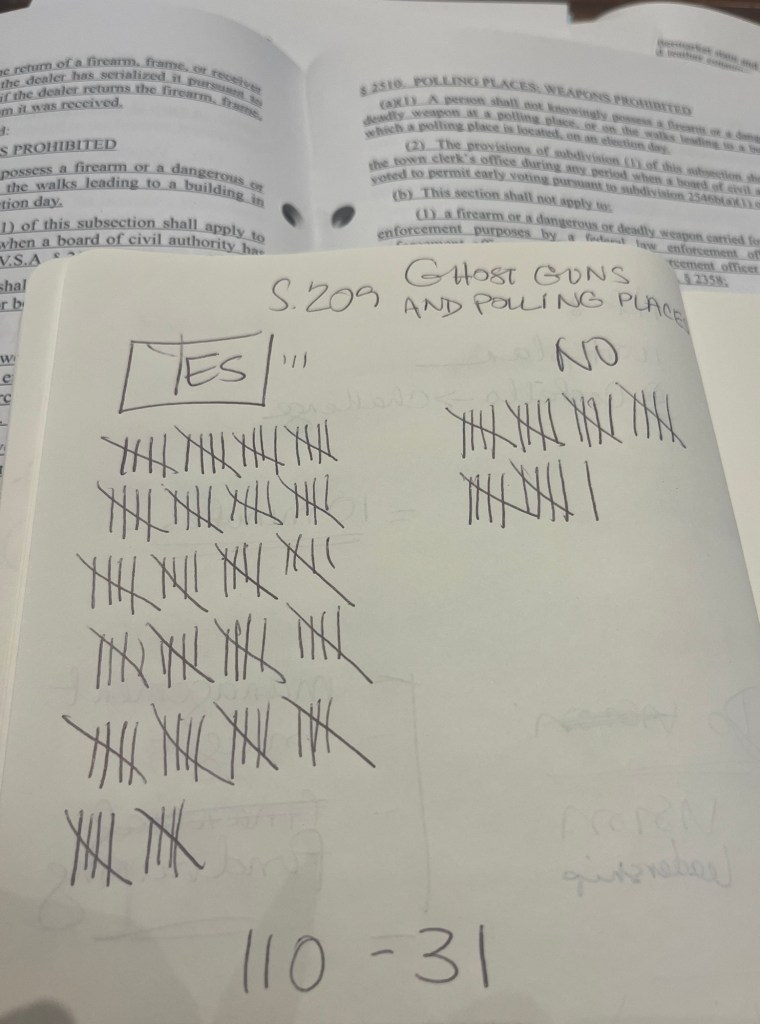
This legislation is designed to regulate the manufacture and possession of firearms, particularly those that could potentially be made untraceable or undetectable. It’s part of an effort to enhance public safety and prevent the misuse of firearms. For more details, you can refer to the full text of the bill here S.209. The bill passed 2nd reading 110-31 on Thursday and is also up on Tuesday for debate before a final vote.
State Regulation of River Corridors S.213 An act relating to the regulation of wetlands, river corridor development, and dam safety
This bill aims to update regulations related to wetlands, river corridors, and dam safety in Vermont. Key provisions include requiring the Agency of Natural Resources (ANR) to regularly update wetland inventory maps and conduct high-quality wetland mapping every five years. It also mandates annual reporting on wetland losses and gains. Additionally, the bill proposes changes to the River Corridor Base Map to prevent development in areas prone to erosion.
Furthermore, the bill seeks to enhance public safety by improving dam inspection and evaluation processes. It renames the Vermont Unsafe Dam Revolving Loan Fund to the Vermont Dam Safety Revolving Loan Fund, expanding project eligibility and funding availability for both emergency and nonemergency projects. The fund would receive contributions from various sources, including loan repayments and public or private donations.
Lastly, the bill would create 16 new positions at ANR. It garnered support from the Vermont League of Cities and Towns.

H.871 An act relating to the development of an updated State aid to school construction program
Still no funding for helping school districts with facilities, but a task force to start organizing plans and design consultants.
- Creates the Facilities Master Plan Grant Program to aid supervisory unions and career and technical education districts in developing compliant master plans.
- Establish a list of prequalified architecture and engineering consultants through collaboration between the Agency of Education (AOE) and Department of Buildings and General Services (BGS).
- Form the State Aid for School Construction Working Group to devise a plan for a statewide school construction aid program.
Fiscal Impact:
- Creation of the State Aid for School Construction Working Group incurs expenses:
- Per diems, mileage, and reimbursements for legislative members estimated at $15,000 in fiscal year 2025.
- Appropriation of $15,000 from the General Fund to the General Assembly in fiscal year 2025 to cover the Group’s travel expenses.
Resilience Implementation Strategy Kick-Off
Learn how the state is preparing for the impacts of climate change.
Montpelier, VT – The State of Vermont is hosting two virtual events on April 22 and 25, 2024, to launch the development of a Resilience Implementation Strategy. The strategy will help prepare Vermont for the effects of climate change and climate-related disasters. Vermonters are invited to join these events to help shape the vision for a climate-resilient Vermont.

Register online with the Climate Action Office:
Over the past year, Vermont has endured significant effects of climate change. Floods, heat waves, and droughts are a few of the climate challenges faced by Vermonters. The Resilience Implementation Strategy is an effort by the State of Vermont to assess existing work to make Vermont more climate-resilient, and prioritize strategies to help Vermonters feel more prepared in their daily life to anticipate, withstand, and recover from the harmful impacts of climate change.
The Strategy will integrate and build on the significant work already done by the State. This includes the Climate Action Plan, the State Hazard Mitigation Plan, the Vermont Agency of Transportation Resilience Improvement Plan, and more. The State aims to complete the Strategy by July 1, 2025.
Secretary Julie Moore of the Agency of Natural Resources, Treasurer Mike Pieciak, and the Climate Action Office will share why a Resilience Implementation Strategy is needed, and what it will accomplish. A facilitated discussion will gather your ideas and input that will help craft a vision for a climate-resilient Vermont.
Learn more about the Resilience Implementation Strategy. If you have registration questions, please contact Sophi Veltrop from the Climate Action Office at sophi.veltrop@vermont.gov or 802-522-9555.
VTDigger: Rep. Monique Priestley: ‘Every breath you take, every move you make…’ As passed out of the House, H.121 is a testament of our commitment to Vermonters that we value their privacy, security, and respect.
A Guide to Spring Cleaning in Vermont: “What Do I Do with This?”:
The Vermont Department of Environmental Conservation (DEC) is encouraging residents to properly dispose of or recycle unwanted household items this spring. The DEC emphasizes the importance of keeping hazardous and recyclable materials out of the trash to protect communities and reduce risks associated with harmful chemicals and potential battery fires. Unwanted items like old TVs, leftover light bulbs, mercury thermostats, leftover paint, and expired batteries can be taken to free special recycling locations across the state.
Special recycling collections save natural resources, reduce carbon emissions and waste, and provide materials that are made into new products, like Local Color Paint, appliances, and batteries.
Residents can bring household hazardous waste (HHW) – including any household, automotive, lawn, or garden products labeled “caution, toxic, danger, hazard, warning, poisonous, reactive, corrosive, or flammable” – to collection events or HHW facilities. Learn about local collections from your waste district or town’s website at 802recycles.com.
For other spring cleaning questions, visit the DEC’s “What Do I Do With This?”, which explains how to get rid of items like tires, scrap metal, medications, and more. You can also learn what to do with things locally by exploring your waste district, alliance, or town’s A-Z Guide, an online, searchable list of waste items, and what to do with them.
Learn more at VTrecycles.com or call 802-828-1138. If Mia Roethlein is not available at 802-522-5926 orMia.Roethlein@Vermont.gov, contact Anne Bijur at 802-522-5783 or Anne.Bijur@Vermont.gov.
Vermont Secretary of State Sarah Copeland Hanzas Announces Upcoming Virtual Forums on Ranked Choice Voting:
Vermont Secretary of State Office and the League of Women Voters of Vermont (LWVVT) are co-hosting a two-part series of virtual forums to discuss Ranked Choice Voting (RCV). RCV is a new method of voting that is gaining interest in Vermont. The forums aim to educate the public, stakeholders, and experts about RCV as the state legislature considers RCV legislation.
The first forum, scheduled for Wednesday, May 1st, from 7:00-8:30pm on Zoom, will provide an overview of RCV and include a simulation to help participants understand how it works. The second forum, scheduled for Wednesday, May 8th, from 7:00-8:30pm on Zoom, will delve into the details of administering RCV elections in Vermont.
The Vermont Secretary of State and the League of Women Voters will be promoting the forums in the coming weeks. Please register here for the May 1st forum and here for the May 8th forum. Questions for the panelists about RCV can be submitted in advance to bkeller@lwvofvt.org.
It continues to be an honor to represent the Windham-2 District in the Vermont House of Representatives.
Monitor the bills I am sponsoring and recorded roll call votes.
As always, if you have suggestions, concerns or critiques please be in touch so we can schedule time to discuss. Please do not hesitate to contact me if you need assistance navigating government services at (802) 384-0233 or lsibilia@leg.state.vt.us. Follow my regular posts online at http://www.laurasibiliavt.com
Rep. Laura Sibilia – Dover, Jamaica, Somerset, Stratton, Wardsboro
Discover more from Vermont State Representative Laura Sibilia
Subscribe to get the latest posts sent to your email.
 Vermont State Representative Laura Sibilia