Good evening,
On Tuesday, June 20th, the legislature reconvened for the purposes of attempting to override 7 bills the governor had vetoed. We unexpectedly adjourned the same day and have returned home back to our year round jobs and families until January 2024, unless the impeachment investigations underway for the Franklin County Sheriff and State Attorney require the House to return for impeachment proceedings. If you missed my first end of the session update, you can read it here.
Over the summer I will spend time working full time at my year round job and on two committees I have been appointed to by the Speaker of the House; the first a group of 4 legislators that will work with utilities, renewable energy developers, environmental advocates and the administration to make recommendations to next year’s legislature on updating Vermont’s renewable energy standard (RES). The RES is a performance standard Vermont’s utilities have been obligated to meet since 2015 – the goal has been to increase renewable energy and decrease fossil fuel use in our electric sector – similar to the Clean Heat Standard passed this year. My priorities in this work: keep the lights on, make sure Vermonters can afford their electric bill, increase renewables where their is increasing load (demand).

The second committee is the six member Joint IT Oversight Committee which is tasked with checking in on Vermont’s IT projects, cyber security and government coordination of both.
I’ll also be continuing to hold monthly office hours. In Dover and Wardsboro these are happening at the town library. While anyone in the district can attend any of these office hours, I’d like to have a convenient recommendation for Jamaica and Stratton as well. Let me know if you have a place that would make sense for a monthly one hour discussion indoors, either on a weekend or at 7 am or 6 pm on a week day. The next office hours are this Saturday, July 1st, at the Dover Free Library at 11 am.
Override Attempts
Five vetoes were overturned by the legislature during the veto session: the FY 2024 Budget, voting on town budget items and offices for 16 and 17 year old’s in Brattleboro, allowing Burlington refugee and asylee residents to vote on Burlington city questions and offices, raising the fees for licensees and certifications for some professions at the Office of Professional Regulation, and the childcare bill.
Two vetoes were not taken up for an override vote during the veto session, but could be taken up when the legislature reconvenes in January: increasing the pay of legislative members and youth interrogation practices. The results of the override votes and how I voted are in bold below:
- Vetoed H.494, An act relating to making appropriations for the support of government | Letter | Veto overridden by a vote of 105-42 in the House and 25-5 in the Senate. I voted yes to override the governor’s veto and explained why in my last post.
- Vetoed H.386, An act relating to approval of amendments to the charter of the Town of Brattleboro | Letter | Veto overridden by a vote of 110-37 in the House and 20-10 in the Senate. I voted yes to override the veto, as I almost always do on municipal charter changes that have been voted on by the town proposing the change for their town only.
- Vetoed H.509, An act relating to approval of amendments to the voter qualification provisions of the charter of the City of Burlington | Letter | Veto overridden by a vote of 111-36 in the House and 21-9 in the Senate. I voted yes to override for the reasons stated above.
- Vetoed S.39, An act relating to compensation and benefits for members of the Vermont General Assembly | Letter | No attempt made to override governor’s veto
- Vetoed H.305, An act relating to professions and occupations regulated by the Office of Professional Regulation | Letter | Veto overridden by a vote of 109-38 in the House and 23-7 in the Senate. I voted yes to override the governor’s veto because fees pay for services and they have not gone up in 6 years. This means services are not keeping pace. These fees are to make sure that those working in specialized positions requiring education or training – have that education and training. One of the roles government plays is in consumer protection. Certification and licensing is a base level of consumer protection,.
- Vetoed S.6, An act relating to law enforcement interrogation policies | Letter No attempt made to override governor’s veto
- Vetoed H.217, An act relating to child care, early education, workers’ compensation, and unemployment insurance | Letter Veto overridden by a vote of 116-31 in the House and 23-7 in the Senate. I voted no to overriding the governor’s veto for two reasons: 1. the means with which the proposal is funded, a payroll tax. I have long opposed efforts to implement a payroll tax for new employment benefits, believing we should first raise the funds to shore up the healthcare system that the previous administration and legislatures greatly expanded access to. The legislature dramatically expanded access to healthcare a dozen years ago, but never added sustainable funding. 2. Additionally, during debate on the bill, I asked about and was assured that there are no protections in this bill related to public funding and Vermont’s constitutionally protected separation of church and state. This is continuing to emerge as a major issue due to Maine’s Carson V. Makin case and Vermont’s school choice and discrimination policies. This was also discussed in my last post.
What’s in the Child Care Bill?
The bill proposes to establish a Prekindergarten Education Implementation Committee; change the pupil weight for prekindergarten students in districts that offer full day programs in a public school setting from -0.54 to 0; expand eligibility for the Child Care Financial Assistance Program (CCFAP) to families with income up to 575% of the federal poverty level (FPL); increase the rates the State pays early care and education providers; provide payments to providers to address readiness, quality and capacity; and require the Secretary of Human Service to provide a plan for the reorganization of the Department for Children and Families (DCF).
Fiscal Impact
The bill would appropriate $71.4 million in fiscal year 2024 for the following:
- $107,500 to AOE to retain a contractor to assist the Prekindergarten Education Implementation Committee and pay per diem compensation and reimbursement of expenses for eligible members.
- $47.3 million to DCF to expand CCFAP eligibility and increase provider rates.
- $4 million to DCF to administer the adjustments to CCFAP.
- $20 million to DCF for one-time readiness payments to providers.
Vermont child care funding boost, payroll tax become law as Legislature overrides governor’s veto
Yield Bill H.492
Act 46 of 2015 introduced the “property dollar equivalent yield,” often called the “homestead property yield” or just the “yield.” The yields are set to ensure that the education fund has enough money to support all anticipated education fund uses in the coming year, after accounting for the other sources of revenue to the Education Fund.
The FY 24 non-homestead tax rate, (businesses and second-home owners) is reduced from $1.466 per $100 of assessed value to $1.391 per $100 of assessed value. This rate is not connected to local spending decisions, and is used to fund education throughout the state.
Average homestead property tax rates, which are linked to local school spending, will be reduced from $1.386 per $100 of assessed value to $1.311 per $100 of assessed value.
Most Vermont homestead taxpayers pay their property taxes based on their income and the FY 2024 rate will remain at 2.32%.
2023 Report on Vermont’s Education Financing
In 2022 the General Assembly enacted and the Governor signed Act 127, “an act relating to improving student equity by adjusting the school funding formula and providing education quality and funding oversight.” Section 19 of the act notes that certain aspects of Vermont’s current system of equalized pupils within a shared education fund distort or prevent a fully equitable and progressive education finance system. Section 19 tasks the Joint Fiscal Office (JFO) with examining and providing alternative options for structuring the following aspects of Vermont’s education finance system:
- methods for cost containment that create equity in school districts’ ability to spend
sufficiently on education to meet student needs, - in collaboration with the Department of Taxes and the Agency of Education, the mechanics for setting the yields in a manner that creates a constitutionally adequate education spending amount for school districts at a level that is determined by education funding experts to be sufficient to meet student needs, and
- funding similar school districts in an equitable manner regardless of their per pupil education spending decisions.
Read the report (I have, and it is really well done!)
VT Saves (S.135)
VT Saves requires employers who do not currently offer a retirement plan to sign up for the program, which will automatically establish a Roth IRA with payroll deductions for their employees. Employees can set their own contribution rate and can opt out of the program if they choose. With no recurring cost to taxpayers or businesses, the program will provide a public retirement plan for over 80,000 Vermonters who are not currently offered a offered a retirement plan through their employer.
Saving for retirement can be daunting, especially if you’re just starting your career and particularly when other bills are competing for your take-home pay. That’s why an automatic-enrollment program like VT Saves will have a transformational impact. For example, employees with access to a retirement plan are fifteen times more likely to save for retirement, which will help more people have a secure retirement, benefit our economy and take pressure off our state budget.
VT Saves was an initiative of Treasurer Mike Pieciak and is set to launch in 2025.
H.127 Sports wagering
From the JFO Fiscal Note: This bill would legalize sports wagering in Vermont and authorize the Vermont Department of Liquor and Lottery (DLL) to operate and regulate sports wagering. DLL would be tasked with negotiating and contracting with at least two but not more than six sportsbook operators to open sportsbooks in Vermont through a mobile platform. If the bidding process fails to result in at least two acceptable operators, DLL may opt to either decline to authorize any operators or to allow a single operator to open a sportsbook.
As part of the bidding process, the bill requires DLL to negotiate a revenue share agreement with operators. The bill does not stipulate a minimum required revenue share or establish a maximum revenue share. The revenue share percentage is applied to adjusted gross revenue for each operator, which is equal to gross revenue minus winnings paid to wagerers, federal excise taxes, and voided bets.
The bill establishes a problem gambling program to be administered by the Department of Mental Health
to provide education, assistance, awareness, treatment, and recovery services to people experiencing
difficulty arising from addictive or problematic gambling.
DEC Ensures Safe Battery Collection and Recycling at Transfer Stations

Montpelier, Vt. – In the past year, several battery fires have occurred at transfer stations throughout the Northeast. The U.S. Environmental Protection Agency reports that lithium-ion batteries caused over 240 fires at 64 facilities between 2013 and 2020. Common sources included consumer devices like cell phones, tablets, laptops, hoverboards, and e-cigarettes.
To help solid waste and recycling workers safely collect batteries and reduce the risk of fires, the Vermont Department of Environmental Conservation (DEC) Solid Waste Program has spent $160,000 to purchase and distribute battery collection safety kits to over 160 public and private transfer stations and Household Hazardous Waste facilities. The kits include fire shield blankets, gloves, and packaging to handle and mail back damaged or defective batteries for recycling.
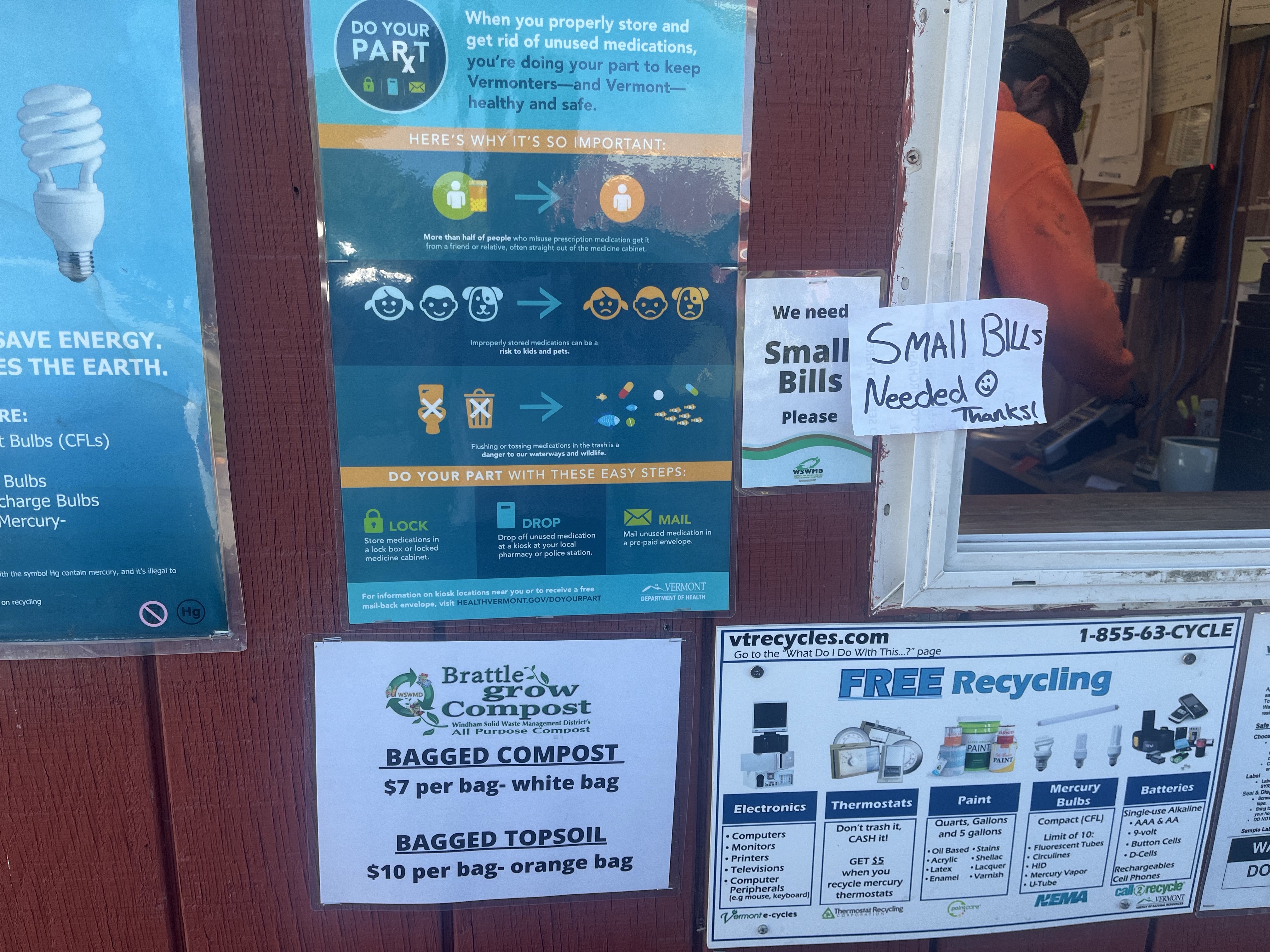
“With the growth of batteries, it is important that both consumers and solid waste managers have the tools to safely and effectively handle them before they pose a fire risk,” says DEC Commissioner John Beling. “Our department has partnered with Call2Recycle, to help get safe battery collection and recycling supplies in place as waste materials continue to change.”
DEC is also providing battery safety training in partnership with Call2Recycle, which operates the Vermont battery recycling program on behalf of battery and product manufacturers.
Consumers are encouraged to safely recycle their leftover single-use and rechargeable batteries at one of 150 battery recycling collection locations in Vermont. If a consumer has a bulging or damaged battery, they should immediately contact their local solid waste management entity to get the damaged battery to a facility that can store and recycle it safely.
“Lithium and lithium-ion batteries are important technology for modern life but must be stored and handled properly to prevent damage,” said Mia Roethlein with the DEC Solid Waste Program. “By collecting these batteries for special recycling, we can protect the environment and human health and capture valuable natural resources.”
To learn more about battery recycling, go to call2recycle.org/vermont. For questions on special battery recycling or other household or business waste, please contact the DEC Solid Waste Program at vtrecycles.com or call Mia Roethlein at 802-522-5926 or Josh Kelly at 802-522-5897.
- VLCT 2023 Legislative Wrap-Up
- SoVermont Young Professional Newsletter
- New laws in Vermont that start July 1: Gun purchases, adoption records, distracted driving and more
- Vermont’s Population Estimates by Age Group: 2021 Compared with 2010
Free Food for Kids
Any household with kids 18 & under can receive 7 days’ of breakfast/lunch: pantry items, fresh produce and milk—per child! Pick up at Jamaica Community Church, Main St, Jamaica or at Leland & Gray high school in Townshend, Friday June 23 from 3-6pm. No registration or other requirements—children do not need to be present during pick-up. Any child, from anywhere, qualifies! This is the first of weekly summer food distribution days. Other dates are July 6, July 13, July 20, July 27, August 3, August 10, August 17. Sponsored by the US Department of Agriculture, and possible through the coordination of West River Education District and volunteers from Jamaica Memorial Library & Jamaica Community Church. See you there for FREE FOOD FOR KIDS! Questions? Want to volunteer? Contact librarian@jamaicavtlibrary.org or 802-874-4901
Monitor the bills I am sponsoring and recorded roll call votes.
As always, if you have suggestions, concerns or critiques please be in touch so we can schedule time to discuss. Please do not hesitate to contact me if you need assistance navigating government services at (802) 384-0233 or lsibilia@leg.state.vt.us. Follow my regular posts online at http://www.laurasibiliavt.com
It is an honor to represent our district in the legislature. Thank you!
Rep. Laura Sibilia – Dover, Jamaica, Somerset, Stratton, Wardsboro
Click here if you are able to help support Laura’s campaign with a $10 donation. Thank you!
Discover more from Vermont State Representative Laura Sibilia
Subscribe to get the latest posts sent to your email.
 Vermont State Representative Laura Sibilia